
True Friends to Appreciate

Aren’t you glad God created animals? I am. They are, and have been, more of a blessing than we may realize. In the Bible, we see animals created in the book of Genesis 1:20-25. Just before creating man to rule over them, God spoke the creatures of the sea into existence first, followed by the birds, and then various kinds of livestock and creatures that moved on the ground. It’s interesting God said, “Let the land produce living creatures….,” so I imagine an astonishing event of animals forming from the ground all over the earth before the eyes of the Lord. Magnificence!

Throughout the ages, animals have been a great help to us as we’ve used them for clothing, food, work, protection, and companionship. God cares about them and has assigned man to rule over them. In Genesis 1:26, “Then God said, “Let us make mankind in our image, in our likeness, so that they may rule over the fish in the sea and the birds in the sky, over the livestock and all the wild animals, and over all the creatures that move along the ground.”
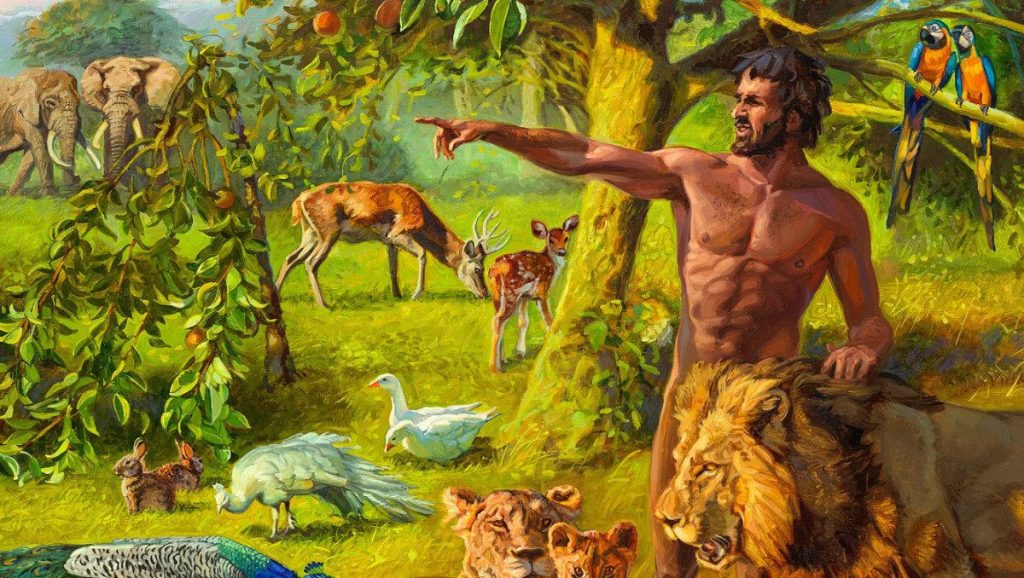
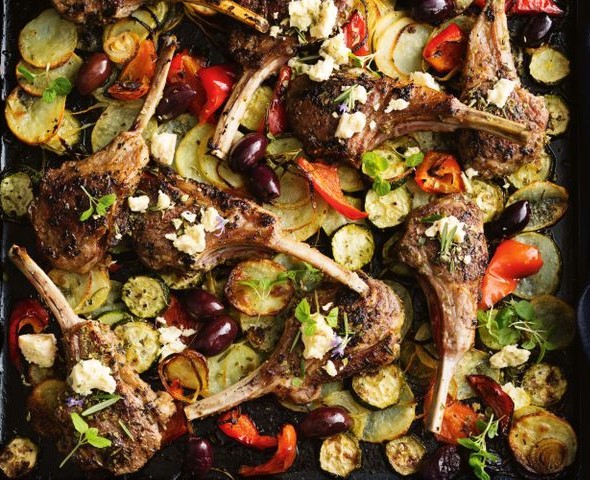
However, mankind didn’t initially start out eating steak and lamb chops on the earth! Before the first couple sinned, their diet was not the meat of animals. As stated in Genesis 1:29-30: “Then God said, “I give you every seed-bearing plant on the face of the whole earth and every tree that has fruit with seed in it. They will be yours for food. And to all the beasts of the earth and all the birds in the sky and all the creatures that move along the ground—everything that has the breath of life in it—I give every green plant for food.” And it was so.”

Nevertheless, eventually, animals were used for clothing, food, and sacrifices to God. After the first man and woman sinned, they created their own plant attire to cover up before God provided His. Today, many drawings, pictures, and films depict the garments God created for them as animal skin. This could very well be the case.
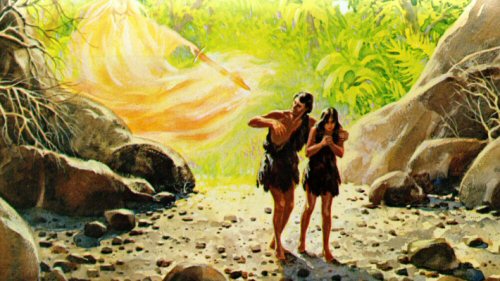
Genesis 3:21 says, “The Lord God made garments of skin for Adam and his wife and clothed them.” It does not specifically say animal skin. So we may conclude it could have been either animal skin or some other kind of material or substance of God’s choosing. However, it does make great sense that perhaps the Lord performed the first sacrifice for sin by killing an animal (shedding blood) and making animal skins of clothing for the first couple.

In Genesis 4:3-4, we see Adam and Eve’s sons, Cain and Abel offering sacrifices to the Lord: “In the course of time Cain brought some of the fruits of the soil as an offering to the Lord. And Abel also brought an offering—fat portions from some of the firstborn of his flock.”  Afterward, we see the practice of animal sacrifice throughout the Old Testament.

Furthermore, in Genesis 8:20-21, God allows the departure of Noah, his family, and all the animals from the ark Noah had built, at the Lord’s instructions, to remain safe from the great flood that would kill every living being outside of it. Noah then proceeds to offer sacrifices to God: “Then Noah built an altar to the Lord and, taking some of all the clean animals and clean birds, he sacrificed burnt offerings on it. The Lord smelled the pleasing aroma and said in his heart: “Never again will I curse the ground because of humans, even though every inclination of the human heart is evil from childhood. And never again will I destroy all living creatures, as I have done.”

Later, in Genesis 9:3, after Noah’s sacrifices to God, with God’s blessing on Noah and his sons, He included: “Everything that lives and moves about will be food for you. Just as I gave you the green plants, I now give you everything.” Now God was allowing more to man’s diet than plants.
In any event, the Bible states God’s animals belong to Him. “The earth is the Lord’s, and everything in it …” (Psalm 24:1) Hence, God considers the well-being of animals and expects us to take care of them. “The righteous care for the needs of their animals, but the kindest acts of the wicked are cruel.” (Proverbs 12:10)

In Jonah 4:11, we see God’s thoughts on the care of animals in one city that had some serious problems. “And should I not have concern for the great city of Nineveh, in which there are more than a hundred and twenty thousand people who cannot tell their right hand from their left—and also many animals?” He didn’t have to mention animals and would not have done so if He didn’t value them.

In conclusion, I’m wondering: Do you have a pet? If so, how has that pet added value to your life? In my eyes, these adorable, majestic, funny, brave, sometimes fearful, and wild creatures are beautiful to behold. Currently, I don’t have one, but I appreciate God’s brilliant fashioning of them.
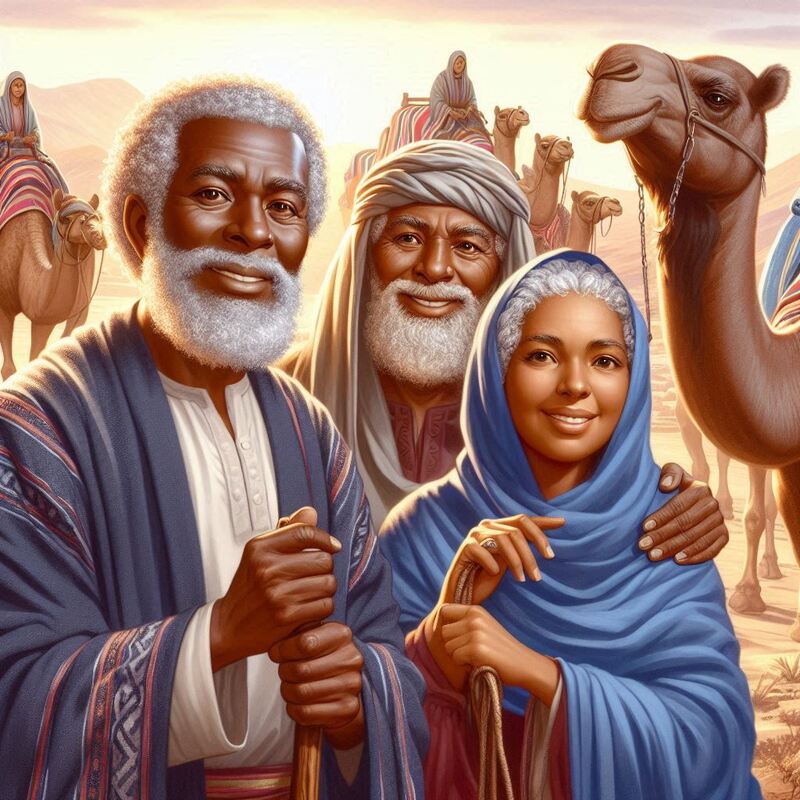
Abraham and Sarah: Lessons in Growth, Faith and Victory

In Genesis 11:27-25:11 of the Bible, we are privileged to see how Abraham and Sarah lived long and strong experiencing God’s blessings and struggles toward their victories in life. In their story, we see the results of their faith as well as those moments of their lack of faith.

Some bible facts about Abraham and Sarah: Abraham’s name was Abram before the Lord changed it. His father was Terah (who lived 205 years), and Abram had two brothers named Nahor and Haran (the father of Lot–Abram’s nephew).

Abram’s wife’s name was Sarai before the Lord changed it to Sarah. She was unable to conceive, so at that time, she had no children.

The Lord told Abram to leave his country and go to where He would show him. Abram at 75 years of age took his wife Sarai, his possessions, and his nephew Lot, and went, obeying the Lord. He went to Canaan, then to Bethel, the Negev, then on to Egypt.

Sarai was a very beautiful woman, so Abram asked Sarai to say she was his sister and not his wife so that his life would be saved and he’d be treated well by the Egyptians.

When the Egyptians saw Sarai, she was taken into Pharaoh’s palace and Abram got special treatment and added wealth because of her. Then God inflicted deadly diseases on Pharaoh and his household, after which he told Abram to take his wife and leave which he did with everything he had, along with Lot, his nephew.

Abram was very wealthy in livestock, silver, and gold. Lot, his nephew, was also wealthy and he and Abram could no longer stay together because of their great possessions, as the land could not support it. Quarreling arose between Abram’s and Lot’s herders, so they decided to separate.

Lot and his possessions got carried off by kings that invaded Sodom and Gomorrah as he had pitched his tents near Sodom which was experiencing war. Abram rescued Lot and brought him back along with his possessions.

Later God told Abram that he would give him an heir from his own flesh and blood. He also told him that he would have offspring numbered as the stars in the sky. The Bible tells us Abram believed the Lord and credited it to him as righteousness.

Since Sarai hadn’t given Abram any children, she asked Abram to sleep with her Egyptian slave to build a family through her. Abram agreed and slept with her slave, Hagar, and she had a son whom she named Ishmael (meaning God hears). Eventually, the slave’s pregnancy and the birth of Ishmael caused some problems in Abram’s household. Yet, God was still quite aware and active in graciously helping and an Angel of the Lord promised to multiply her descendants greatly. Abram was 86 years old when Hagar birthed Ishmael.

When Abram was 99 years old, the Lord appeared to him and established his covenant of circumcision promising to greatly increase his numbers and that he’d be the father of many nations. Also, at that time, the Lord changed his name from Abram to Abraham and his wife’s name from Sarai to Sarah, promising she would give Abraham a son, be the mother of nations, and that kings of people would come from her.

During a visit from three men including the Lord, Abraham was told that by that time of the next year, Sarah would have a son. The Bible describes Abraham and Sarah as “already very old” at this time. Sarah was listening and laughed, but out of fear denied she laughed. Yet, by the next year, Sarah gave birth to a baby boy named Isaac. She was 90 years old when Isaac was born and her husband, Abraham was 100.

I’ve only chosen to highlight a few facts about Abraham and Sarah’s exciting life of faith, so as not to go beyond the few minutes I have with you.

I find it remarkable that by faith, Abraham left his family and the land he knew without knowing where he was going. However, his faith did not allow him to have enough courage to tell the truth about Sarah being his wife and trusting God to keep them both safe. He risked her being sexually violated out of fear, but God was faithful and showed everyone who was boss. He would not have her harmed.

Moreover, for Sarah to attempt to speed up God’s promise of birthing a child by giving her slave to Abram, without any mention in the Bible of hesitation from him, but agreement, is somewhat disappointing, though understandable.

Nevertheless, before Sarah’s death at 127 years of age, and Abraham’s at 175, their lives were filled with faith lessons and victories from which our own faith is now inspired.

So what can we, God’s children, do or accept by faith today? What seems impossible or too difficult to do, or believe, that God has actually said would happen for us individually and corporately as Jesus’ body of believers? We should remember the lives of Abraham and Sarah, great lessons in faith, and God’s supernatural ability to bring His will to pass.