
Receiving God’s SUPERnatural

The Bible is so magnificent, but there are times when some of its contents are difficult to accept as truth. Yet that doesn’t negate the validity of its scriptures. Of the Bible’s many astonishing events, I recently remembered its fig tree story and how it relates to us.

In Mark 11, we find Jesus leaving Bethany, hungry. He sees a fig tree from a distance and decides to go check if it has any fruit. He finds nothing but fig leaves as it was not the season for figs. Then, within the disciples’ hearing, he speaks to the tree, “May no one ever eat fruit from you again.”

Afterwards, Jesus and his disciples arrive in Jerusalem and encounter the buying and selling of various items in the temple courts. Jesus is displeased and lets all involved know just how much by overturning the moneychangers’ and sellers’ tables and benches, and not allowing anyone to carry merchandise through the temple courts. He reminds them of what was written, that his house would be called “a house of prayer for all nations,” but they had made it “a den of robbers.”

Jesus and his disciples leave the city that evening, and in the morning, they pass by the same fig tree they had seen the previous day. His disciples, no doubt, are surprised as they tell him the fig tree he cursed has withered. His response was, “Have faith in God.” “Truly I tell you, if anyone says to this mountain, ‘Go, throw yourself into the sea,’ and does not doubt in their heart but believes that what they say will happen, it will be done for them. Therefore I tell you, whatever you ask for in prayer, believe that you have received it, and it will be yours.”

Interestingly, He also adds, “And when you stand praying, if you hold anything against anyone, forgive them, so that your Father in heaven may forgive you your sins.” My first thoughts on reading this passage were, “Do we in any way really believe what he said?”

Since we’re dedicated followers of Jesus today, that would also make us his disciples, too. Hence, along with our prayer requests, Jesus emphasizes forgiving others when we’ve been offended, so that we are also forgiven. However, I’m awed by the fact that He specifically says that whatever we ask for in prayer, believing we’ve received it, will be ours. In addition, I can surmise that how and when we receive it may differ from our expectations. Nevertheless, I choose to accept what is clearly written. Whatever prerequisites we might find to apply, this is what I call the SUPERnatural of God available to us. Evidently, some things we may encounter in God cannot be logically explained. Yet it is truly a blessing to faithfully receive them.

Jesus even attributes this amazing, supernatural ability to having faith in God. This is where our faith should be directed. Then highlighting “Truly,” He wants us to really get that this is no joke, if one were to say to a mountain to throw itself into the sea and not doubt in their heart, but believe what they’ve said, it will be done for them. Now I don’t know about you, but I find this difficult to imagine, and yet when you study and meditate on who God is and how powerful He is, it becomes easier to receive. Further, if it were not so, Jesus would not have said it.

My guess is some of us will find ways to explain this passage as meaning something else, or there being some other necessary conditions. However, it appears quite clear in His teaching we should:

  1. put our faith in God (not in anything or anyone else);
  2. say what we desire or speak to the obstacle (don’t see this as a time for just thinking a prayer silently);
  3. believe it will happen and not doubt (this is where we’ve often missed it); and
  4. forgive people for any offenses committed against us (another place we may have fallen short).

Passages like this can be very controversial and said to be “name it and claim it” in nature. Nevertheless, one can’t argue that they are in the Bible and Jesus did say what we should say. Not to mention he stated, “If anyone says…” So I’d suppose this isn’t just a reference to church leadership. Wow!

Moreover, there are several other supernatural passages such as these in the Bible that I’m finding many teachers tend not to mention these days. I suppose it is to avoid having to answer to all the critics and their “what-ifs” that they’d be expected to explain. However, I figure what I don’t know, I don’t know, but whatever Jesus said, I can and should repeat it; even if it goes against my human logic.

Thankfully, I’m remembering, Jesus speaking to the centurion in Matthew 8:13: “Go! Let it be done just as you believed it would.” And his servant was healed at that moment.

As I continue on my reading journey through the Bible from 2023, I’m adding another study on faith in 2024. It’s crucially important. We can’t please God without it (Hebrews 11:6).

A Truly Merry Christmas

Yes! So, with all the excitement of shopping, giving, singing, and eating, the true reason for the season is never really lost, though for some forgotten. God has been merciful to us and given us a Savior who has delivered us from our sins. He provided the atonement to reconcile us to Himself and surely we are glad about it!

Of course, we know that December 25th is not the date on which He was born (as far as we know). However, we have the freedom to celebrate responsibly as we choose! Isn’t that a blessed thing?

Image by Drazen Zigic on FreePik

To realize that the one who has lived since the very beginning, who sees past the very end, loves and wants us for eternity? He left his home of infinite glory to be born of a mere woman and live a life of what must have seemed like misery to bring us into an intimate relationship with himself. What can be greater than that? Other than to lay down that life in pain and torture as the supreme sacrifice for those He loved.

The definition of this day of celebration is of such great importance to the world even though so many may not know or want to understand it. So I encourage you to celebrate in any way you know how to show your gratitude and realization of the truth of the matter: God Almighty loves us immensely!

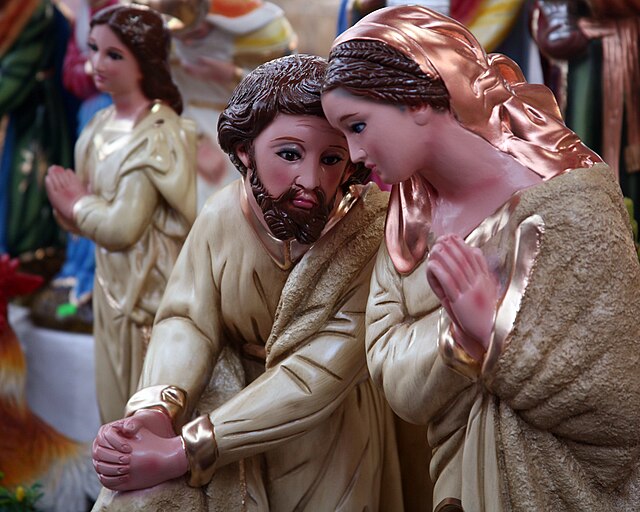
I can only hope that when we’ve reached that most high place of abundant joy in heaven, Jesus will somehow display that great rewind of the event when both Mary and Joseph were enlightened to that miraculous time to come when they would conceive and raise the Son of the Most High God: Immanuel!

I’m wishing you all the joy and happiness of the season: Merry Christmas!

Who’s To Judge?

There’s a phrase that we’ve all heard and may have even said at some point in our lives: “Don’t judge me.” It suggests we should not form a conclusion about a person with condemnation. Perhaps it’s even more than just examining the fruit of a person’s life, but passing a judgment where we don’t have the information about the person that God would have. Or the event we may not have the authority to judge.

Practically, every day in various ways we navigate through life with decision-making. We make determinations about what actions to take next on matters as well as who we seek for guidance, support, or friendship. But how might this relate to communicating with or evaluating another person? Or should we even assess people? Might we just pray about them and see if the Lord approves?

The Greek word for “judge” in the Bible is krino, which means to pronounce an opinion concerning right and wrong. Other definitions include to condemn, sentence, or levy a punishment. The scriptures are pretty clear in their references to judging. First, we’re told: “Judge not, that you be not judged. For with what judgment you judge, you will be judged; and with the measure you use, it will be measured back to you. And why do you look at the speck in your brother’s eye, but do not consider the plank in your own eye? Or how can you say to your brother, ‘Let me remove the speck from your eye’; and look, a plank is in your own eye? Hypocrite! First, remove the plank from your own eye, and then you will see clearly to remove the speck from your brother’s eye” (Matthew 7:1-5/NKJV).

Hence, though we are told not to judge, it appears in Matthew 7:5 that we are allowed to move forward to help our brother when we’re able to see clearly to remove a speck from his eye when we’ve removed the plank from our own. In doing this we are taught in Galatians 6:1/NIV “… if someone is caught in a sin, you who live by the Spirit should restore that person gently. But watch yourselves, or you also may be tempted.” So, we are shown in what Spirit we are to restore a person.

We are careful when we remember John 5: 22-23, “Moreover, the Father judges no one, but has entrusted all judgment to the Son, that all may honor the Son just as they honor the Father. …” In addition, James 4:12/NIV, “There is only one Lawgiver and Judge, the one who is able to save and destroy. But you—who are you to judge your neighbor?”

At the same time, Matthew 18:15-17/NIV tells us how to deal with sin in the church: “If your brother or sister sins, go and point out their fault, just between the two of you. If they listen to you, you have won them over. But if they will not listen, take one or two others along, so that ‘every matter may be established by the testimony of two or three witnesses.’ If they still refuse to listen, tell it to the church; and if they refuse to listen even to the church, treat them as you would a pagan or a tax collector.”

Further, we’re reminded in 1 Corinthians 6:1-5/NLT, “When one of you has a dispute with another believer, how dare you file a lawsuit and ask a secular court to decide the matter instead of taking it to other believers! Don’t you realize that someday we believers will judge the world? And since you are going to judge the world, can’t you decide even these little things among yourselves?  Don’t you realize that we will judge angels? So you should surely be able to resolve ordinary disputes in this life. If you have legal disputes about such matters, why go to outside judges who are not respected by the church?  I am saying this to shame you. Isn’t there anyone in all the church who is wise enough to decide these issues? “

Another reference to judging is found in John 7:24/NKJV where Jesus says, “Do not judge according to appearance, but judge with righteous judgment,” another definition of “judgment” that would be valid. The Lord does not want us to be like the Pharisees whom he considered hypocritical in that they condemned others for the same sins they were committing.

Therefore, I’ve concluded we must look at all of the Bible’s references to judging to be able to accurately understand when and how to judge. We must remember the authority of the Bible in that, “All Scripture is God-breathed and is useful for teaching, rebuking, correcting and training in righteousness, so that the servant of God may be thoroughly equipped for every good work” (2 Timothy 3:16-17/NIV). We know there are certainly times when encountering a problem and teaching the scripture as the solution is necessary.

There is much to be learned in the Bible about how we are to treat one another, all provided by the Scriptures, along with the Holy Spirit available to help us succeed. This is why we need to read the Bible daily and walk by the Spirit so that we can be obedient to God’s commands regarding judgment. Through consistent time spent with the Lord in prayer and study of the scriptures for knowledge and understanding, we prepare ourselves for the challenges we are certain to face in relationships.

So, What’s the Tea?

Thinking about your most recent conversations, would you say that they involved talking about other people and their lives? Or, do you find yourself desiring to read information about other people and what is happening to date? Do you believe the people you receive from are reliable sources of truth and is the information edifying or inspirational to your life?

In this day and age of social media and other forms of communication, there are so many opinions, and more comments than ever on other people’s lives, many times with truth being embellished or exaggerated. A safeguard is needed to discourage gossip and avoid furthering possible erroneous information about others.

What exactly is gossip? Oxford Learner’s Dictionary describes it as, 1) informal talk or stories about other people’s private lives, that may be unkind or not true; 2) a conversation about other people and their private lives; and 3) a person who enjoys talking about other people’s private lives. Sadly, these definitions would most likely apply to all of us at one time or another.

The Bible teaches that, “A gossip betrays a confidence, but a trustworthy person keeps a secret” (Proverbs 11:13). Further, “A perverse person stirs up conflict, and a gossip separates close friends” (Proverbs 16:28). It reminds us that, “Those who consider themselves religious and yet do not keep a tight rein on their tongues deceive themselves, and their religion is worthless” (James 1:26). It also condemns gossip as being inappropriate for Christians and a consequence of a depraved mind (Romans 1:29; 2 Corinthians 12:20).

If there’s one thing we hopefully know, is that sometimes, people will lie about others for any number of reasons, which might often include sensationalism, especially for media purposes.

It’s important to realize it’s best not to repeat anything about someone else that doesn’t come straight from that person’s mouth for public knowledge. Moreover, it makes good sense not to believe everything one hears about a person as factual, without personal knowledge of the information as being true.

Two scriptures, one in the Old Testament and the other in the New Testament, teach us about the importance of witnesses in a matter:

  1. 2 Corinthians 13:1
    … “By the mouth of two or three witnesses, every word shall be established.”
  2. Deuteronomy 9:15
    “One witness shall not rise against a man concerning any iniquity or any sin that he commits; by the mouth of two or three witnesses the matter shall be established.”

It may take some time to break oneself from a habit of gossiping, but it is possible as we remind ourselves of what God thinks of the matter and pray for His grace to help us to place a “tight rein on our tongues.” Or, perhaps I should add keyboards.