People seek happiness or “the good life” in many things. However, according to God’s wisdom, only a few things are required to achieve it.
If we truly desire a full life of peace, success, favor, and good health, here within three bible passages, is God’s prescription:
1.Proverbs 3:1-2/NIV My son, do not forget my teaching, but keep my commands in your heart, for they will prolong your life many years and bring you peace and prosperity.
2.Proverbs 3:3-4/NIV Let love and faithfulness never leave you; bind them around your neck, write them on the tablet of your heart. Then you will win favor and a good name in the sight of God and man.
3.Proverbs 3:7-8/NIV Do not be wise in your own eyes; fear the Lord and shun evil. This will bring health to your body and nourishment to your bones.
To practice God’s wisdom in obtaining happiness in life, we must first know:
1. God’s commands;
2. God’s definitions of love and faithfulness;
3. what it means to fear the Lord; and
4. how to identify evil, and avoid it.
We learn God’s commands by availing ourselves of His resources (i.e., the Bible; the gifts Christ gave to the church: the apostles, prophets, evangelists, pastors, and teachers; and other Holy Spirit-led, wise counselors).
Godly love and faithfulness entail traits such as compassion, kindness, humility, steadfastness, honor, empathy, sacrifice, forgiveness, and patience.
Fearing the Lord denotes reverencing and holding Him in high regard; appreciating and acknowledging Him; placing Him first in our lives; and showing Him the utmost respect He deserves.
Discerning good and evil is accomplished by the study of God’s Bible and the indwelling of His Spirit within us. Right and wrong are clearly established in His word, as well as the laws of our society that can be traced back to the Bible. In addition, hopefully, wise training in good and evil is also provided by one’s parents or guardians.
The length of time and maturity in applying these things will prove different for every believer. However, we are blessed beyond measure to have God’s grace and wisdom during our growth.
I love how the Bible takes us through the lives of kings and others, showing us those who followed the ways of the Lord, those who didn’t, and the life consequences of both. In reading 2 Chronicles, I’ve pondered the life of King Uzziah. He was only 16 years of age when the people of Judah made him king in place of his father Amaziah. He had a fruitful life of adventure with the Lord’s assistance, but somehow, later, veered off of his God-given course of life, and got shipwrecked.
The Bible describes King Uzziah as initially doing what was right in the eyes of the Lord, as his father Amaziah had done. He sought the Lord following Zechariah’s teachings in the fear of God and as long as he did, God made him successful.
Image: 2024 Microsoft Designer
God helped King Uzziah fight victoriously against his enemies, and the Bible says he became famous and very powerful. He built and fortified towers in Jerusalem and the wilderness. He had a lot of livestock and people working his fields and vineyards.
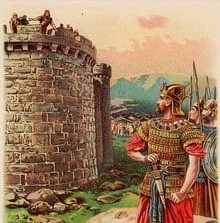
King Uzziah also had a well-trained army of 307,500 men for which he provided various weaponry for the entire army, and 2,600 family leaders over them. The Bible tells us in 2 Chronicles 26:14, that King Uzziah provided “shields, spears, helmets, coats of armor, bows and sling stones for the entire army.” In addition, he created devices for use on the towers and corner defenses so that the soldiers could fight, shooting arrows and hurling stones appropriately.
With all of this, the Bible tells us, King Uzziah’s “fame spread far and wide, for he was greatly helped until he became powerful.”
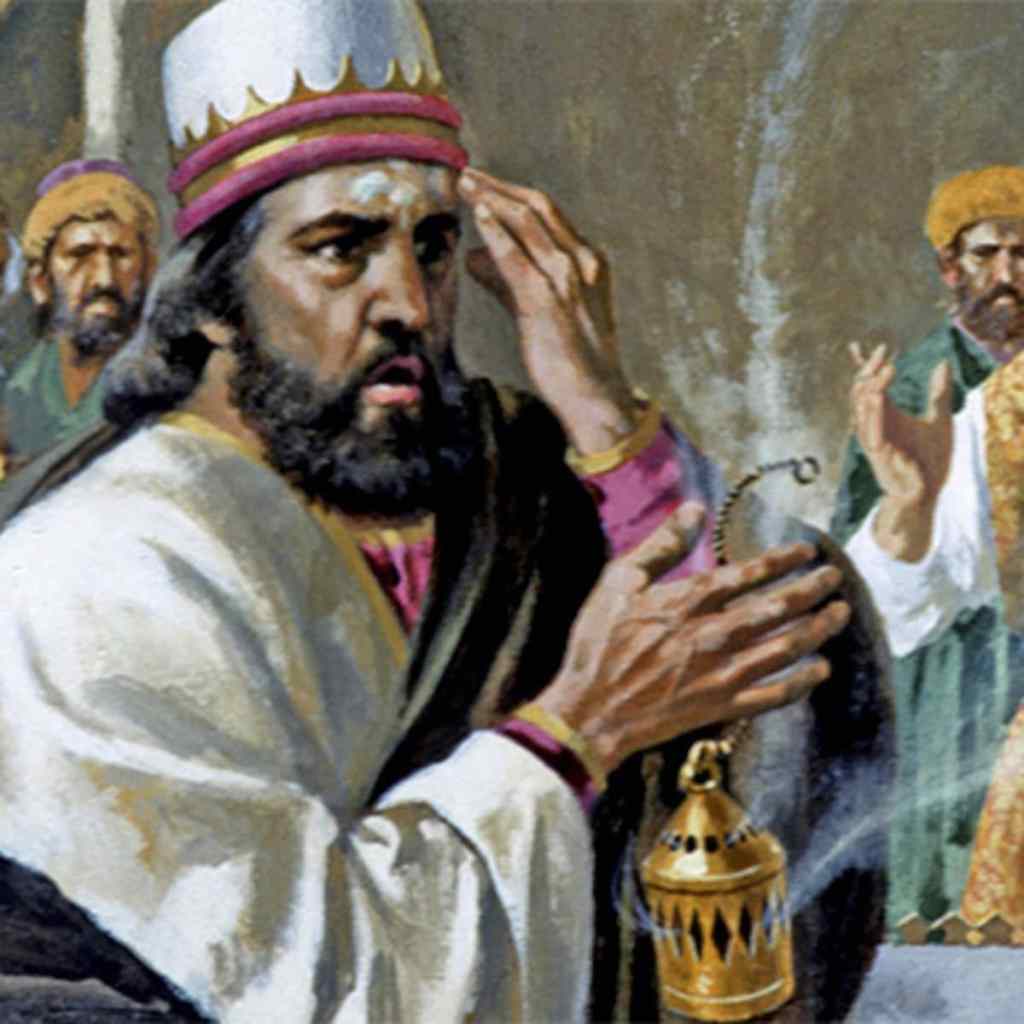
Unfortunately, with Uzziah’s great power and success, came pride, which led to his downfall. We are shown that Uzziah was unfaithful to God and entered the temple to burn incense on the altar of incense. ( A big no-no!) Azariah the priest along with eighty other priests followed King Uzziah in the temple and confronted him about it, telling him he was wrong to do so.
Only priests, descendants of Aaron, who had been consecrated to burn incense were approved to offer incense. He was told to leave the sanctuary as he had been unfaithful and would not be honored by God.
Image: DrawforGod.com
Consequently, King Uzziah got angry, and while holding a censer ready to burn the incense, the Bible says he was raging at the priests. Can you imagine? In the temple, in the presence of God, this going on? Raging isn’t a polite word and denotes violent uncontrollable anger via Merriam-Webster, and stormy, furious, and turbulent behavior in Hebrew.
Then, the chief priest and all the others looked at King Uzziah as leprosy broke out on his forehead. Hence, the priests hurried him out, and he “was eager to leave because the Lord had afflicted him.” (2 Chronicles 26:20)
Image: 2013 – V. Gilbert and Arlisle F. Beers/Lynn Maynard
Sadly, King Uzziah had leprosy for the rest of his life, was banned from the temple, and had to live in a separate house, with his son, Jotham, having charge of the palace and governing the people. King Uzziah served as king of Judah in Jerusalem for fifty-two years, after which He was buried near his ancestors in a cemetery belonging to kings, as he was spoken of as having leprosy. His son Jotham became the next king.
Video:Bible Investigators TV
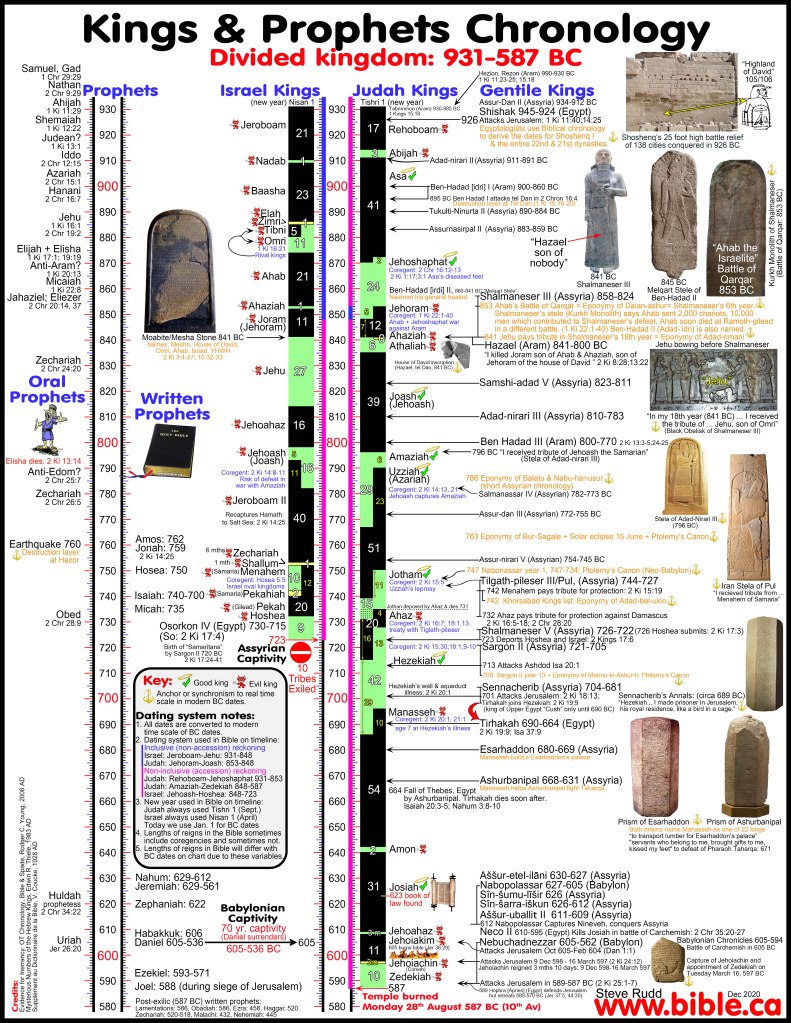
Tragically, someone may start life well and later end up losing everything of importance because of their own poor decisions. King Uzziah followed in the footsteps of his dad, King Amaziah, beginning well, but ending poorly. As well, King Amaziah followed in the footsteps of his father, King Joash, who also started his reign righteously, but ended woefully. Dismally, King Ahaziah, King Joash’s dad, did evil in God’s sight, following his father King Jehoram, who also lived wickedly and died of a painful intestinal disease.
Steve Rudd/www.bible.ca
Unfortunately, oftentimes great power and authority can make us full of arrogance and self-conceit. The Bible warns us of the danger of pride: “When pride comes, then comes disgrace, but with humility comes wisdom.” (Proverbs 11:2) “The LORD detests all the proud of heart. Be sure of this: They will not go unpunished.”(Proverbs 16:5) “Pride goes before destruction, a haughty spirit before a fall.” (Proverbs 16:18)
David Diga Hernandez, Evangelist
Perhaps the best action for any of us in the family of God would be to pray daily that the Holy Spirit would help us to maintain a consistent spirit of humility in all of life; recognizing, denouncing, and shunning any prideful temptations the enemy would send to destroy us, and our witness for the Lord. I mention denouncing because sometimes exposing or speaking against what we know to be a temptation, as well as praying, can be a strong source of defense against pride. Not to mention, just staying in our lane.
Aren’t you glad God created animals? I am. They are, and have been, more of a blessing than we may realize. In the Bible, we see animals created in the book of Genesis 1:20-25. Just before creating man to rule over them, God spoke the creatures of the sea into existence first, followed by the birds, and then various kinds of livestock and creatures that moved on the ground. It’s interesting God said, “Let the land produce living creatures….,” so I imagine an astonishing event of animals forming from the ground all over the earth before the eyes of the Lord. Magnificence!
Throughout the ages, animals have been a great help to us as we’ve used them for clothing, food, work, protection, and companionship. God cares about them and has assigned man to rule over them. In Genesis 1:26, “Then God said, “Let us make mankind in our image, in our likeness, so that they may rule over the fish in the sea and the birds in the sky, over the livestock and all the wild animals, and over all the creatures that move along the ground.”
However, mankind didn’t initially start out eating steak and lamb chops on the earth! Before the first couple sinned, their diet was not the meat of animals. As stated in Genesis 1:29-30: “Then God said, “I give you every seed-bearing plant on the face of the whole earth and every tree that has fruit with seed in it. They will be yours for food. And to all the beasts of the earth and all the birds in the sky and all the creatures that move along the ground—everything that has the breath of life in it—I give every green plant for food.” And it was so.”
Nevertheless, eventually, animals were used for clothing, food, and sacrifices to God. After the first man and woman sinned, they created their own plant attire to cover up before God provided His. Today, many drawings, pictures, and films depict the garments God created for them as animal skin. This could very well be the case.
Genesis 3:21 says, “The Lord God made garments of skin for Adam and his wife and clothed them.” It does not specifically say animal skin. So we may conclude it could have been either animal skin or some other kind of material or substance of God’s choosing. However, it does make great sense that perhaps the Lord performed the first sacrifice for sin by killing an animal (shedding blood) and making animal skins of clothing for the first couple.
In Genesis 4:3-4, we see Adam and Eve’s sons, Cain and Abel offering sacrifices to the Lord: “In the course of time Cain brought some of the fruits of the soil as an offering to the Lord. And Abel also brought an offering—fat portions from some of the firstborn of his flock.” Afterward, we see the practice of animal sacrifice throughout the Old Testament.
Furthermore, in Genesis 8:20-21, God allows the departure of Noah, his family, and all the animals from the ark Noah had built, at the Lord’s instructions, to remain safe from the great flood that would kill every living being outside of it. Noah then proceeds to offer sacrifices to God: “Then Noah built an altar to the Lord and, taking some of all the clean animals and clean birds, he sacrificed burnt offerings on it. The Lord smelled the pleasing aroma and said in his heart: “Never again will I curse the ground because of humans, even though every inclination of the human heart is evil from childhood. And never again will I destroy all living creatures, as I have done.”
Later, in Genesis 9:3, after Noah’s sacrifices to God, with God’s blessing on Noah and his sons, He included: “Everything that lives and moves about will be food for you. Just as I gave you the green plants, I now give you everything.” Now God was allowing more to man’s diet than plants.
In any event, the Bible states God’s animals belong to Him. “The earth is the Lord’s, and everything in it …” (Psalm 24:1) Hence, God considers the well-being of animals and expects us to take care of them. “The righteous care for the needs of their animals, but the kindest acts of the wicked are cruel.” (Proverbs 12:10)
In Jonah 4:11, we see God’s thoughts on the care of animals in one city that had some serious problems. “And should I not have concern for the great city of Nineveh, in which there are more than a hundred and twenty thousand people who cannot tell their right hand from their left—and also many animals?” He didn’t have to mention animals and would not have done so if He didn’t value them.
In conclusion, I’m wondering: Do you have a pet? If so, how has that pet added value to your life? In my eyes, these adorable, majestic, funny, brave, sometimes fearful, and wild creatures are beautiful to behold. Currently, I don’t have one, but I appreciate God’s brilliant fashioning of them.
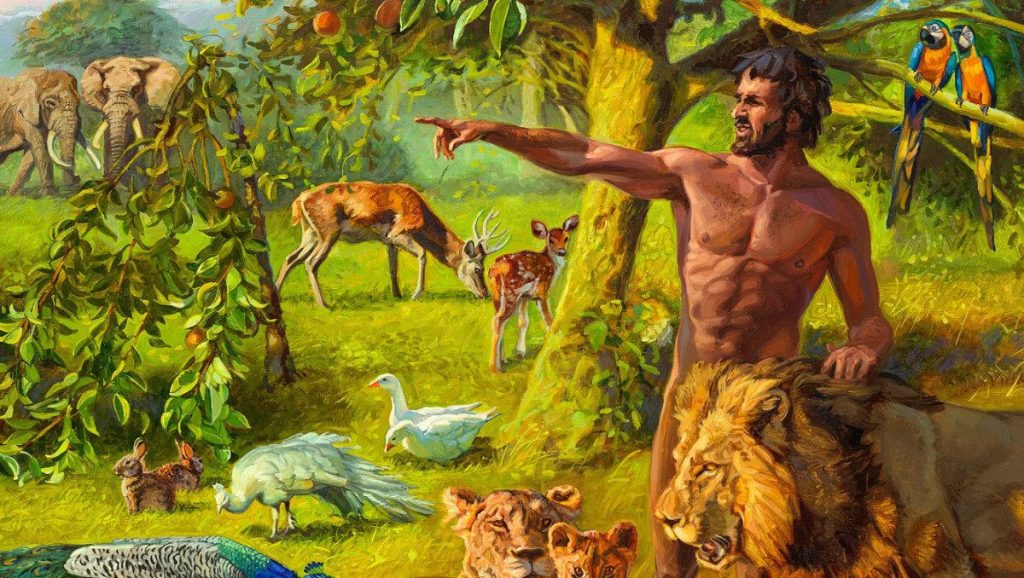
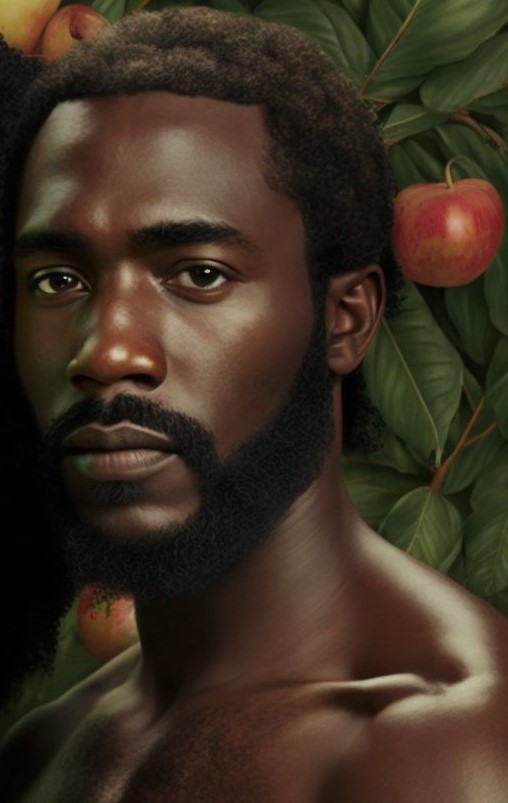
Can you imagine waking up for the first time and finding you are the only human being on the planet? It’s quite interesting to read the Bible and find out that we all descended from one man who experienced such an event. Perhaps the more we think about this, the more of a respectful mindset toward one another we’ll possess. The fact that we all look very different in our various colors, shapes, and sizes, as well as come from all kinds of places, doesn’t negate the reality that we all originated from one person.
At the beginning of the creation of the heavens and the earth in Genesis 2:7, we find that “the Lord God formed a man from the dust of the ground and breathed into his nostrils the breath of life, and the man became a living being.” In verse 15, ” The Lord God took the man and put him in the Garden of Eden to work it and take care of it.” Then in verse 18, the Lord says, “It is not good for the man to be alone. I will make a helper suitable for him.”
Illustration by Caleb Salisbury
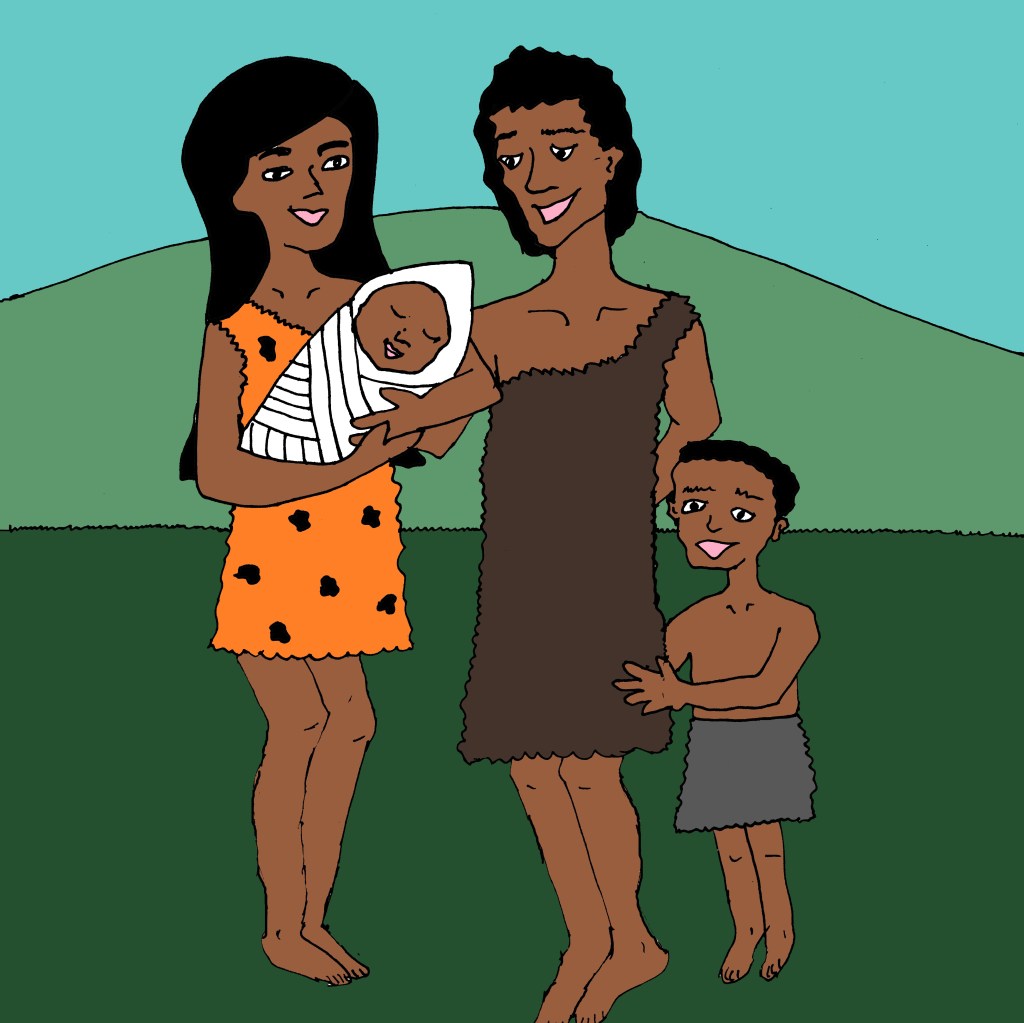
Afterward, the Lord caused the man to fall into a deep sleep and while he slept, took one of the man’s ribs and made a woman from that rib. The man, Adam, named the woman Eve, who became pregnant with her first two sons, Cain, and later Abel. At this point, we see the start of one huge family of mankind, originating from one man God created, who grew into all of us on earth today.
Illustration: Teach and Grow
We are told in Acts 17:26-27, that “from one man he made all the nations, that they should inhabit the whole earth; and he marked out their appointed times in history and the boundaries of their lands. God did this so that they would seek him and perhaps reach out for him and find him, though he is not far from any one of us.”
So why do so many of us still struggle with the various color distinctions of the human race God created on His earth? These differences are constantly highlighted and labeled in various ways. Yet, the Lord tells us in 2 Corinthians 5:16, that we should regard no one according to the flesh; and in 1 Samuel 16:7, the Lord doesn’t see as man does; the man looks at the outward appearance, but the Lord looks at the heart.
For those of us who are Christ’s followers, this reality of life speaks even louder following Jesus’ death and resurrection, “for all of you who were baptized into Christ have clothed yourselves with Christ. There is neither Jew nor Gentile, neither slave nor free, nor is there male and female, for you are all one in Christ Jesus. If you belong to Christ, then you are Abraham’s seed, and heirs according to the promise.” (Galatians 3:27-29) In light of this amazing truth, our thoughts on a person’s skin color or birthplace should not present a problem for one’s existence in any way. Clearly, the Bible shows us in many ways that one’s spiritual alignment, character, motives, and behavior are of the most importance.
Consequently, we’ve still got some work to do to embrace and live the truth that we are all one human race of people (whether we like it or not) and should see ourselves as such. If we are Christ’s disciples or ambassadors, we are one family, our aim being to love God and one another past our skin color or birthplace; and treat one another as we desire to be treated.
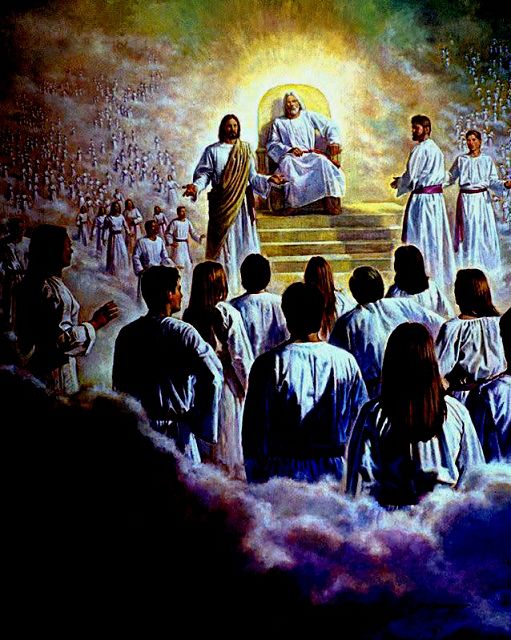
We’ll no doubt get a lot further along well on the earth, the closer we get to this goal. Not to mention reality extends into eternity as shown in Revelation 7:9, ““After this I looked and there before me was a great multitude that no one could count, from every nation, tribe, people and language, standing before the throne and in front of the Lamb.”




















 Ms. Rita's Minute