Crucial Observations

“We should not commit sexual immorality,

as some of them did—and in one day 23,000 of them died.”

(1 Corinthians 10:8)

These days, some people may call me negative for highlighting this scripture verse. However, I remind myself of its importance as much as I would anyone else, especially if it means saving one’s life.

This verse is related to the Apostle Paul’s warning to the Corinthian church about those events that happened to the Israelites that later served to show God’s people the consequences of setting their hearts on doing ungodly things.

Paul reminded them that their ancestors, all baptized as Moses’ followers, ate the same spiritual food, but God wasn’t pleased with most of them. As a result, their bodies ended up scattered in the wilderness.

They reaped fatal results because they gave themselves to the following behaviors:

a. idolatry – the act of worshipping idols or placing anything other than God as the primary focus of one’s devotion, essentially putting something else in the place of God,

b. revelry – excessive, uncontrolled partying or celebration, often associated with pagan worship practices, including feasting, drinking, and dancing,

c. sexual immorality – sexual activity outside of marriage, including adultery, fornication, and other sexual acts considered morally wrong,

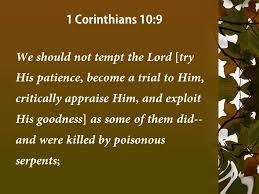
d. testing Christ – the act of deliberately putting God’s power and faithfulness to the test by engaging in risky or questionable behavior, and
e. grumbling – complaining or murmuring against God.

Sexual immorality not only killed 23,000 of them in one day, but putting God to the test caused deadly snake bites, and grumbling caused them to be destroyed by the angel of death.

Paul then goes on to tell them to be careful not to fall by thinking they are so strong; that the temptations in their lives were no different from what others experience. However, God being faithful, wouldn’t allow them to be tempted more than they could stand, and would show them a way out so that they could endure.

He also warned them regarding sacrifices offered to demons, that he didn’t want them participating with demons; that they could not eat at the Lord’s table and the table of demons at the same time and not arouse the Lord’s jealousy.

Where in another instance Paul advises people to flee fornication, here he says to flee the worship of idols. In fleeing, I imagine someone running. Also, he continues with, though one may say they are allowed to do anything, everything isn’t beneficial.

Finally, an important reminder is that even though these things occurred in the Old Testament of the Bible, we are told in 1 Corinthians 10:11, “These things happened to them as examples for us. They were written down to warn us who live at the end of the age.” So, we’d all be wise to pay close attention to these crucial lessons.


Successful Planning

Plans are established by seeking advice;
    so if you wage war, obtain guidance
(Proverbs 20:18).

Have you made any plans lately? If so, perhaps they relate to your family, friends, jobs, homes, ministries, health, and finances—all important to most of us.

Planning can actually be fun and at the same time stressful. It forces us to think about all that we really want or need in a particular area of our lives. It moves us to be specific about the steps we need to take to reach our desired outcomes and requires our time and effort to develop.

Thankfully, Proverbs 20:18 provides us with a means to successful planning: advice. Counsel or guidance is an important part of wisdom in planning. Sources of direction may come through a parent, close friend, church leader, therapist, or another person of wisdom. Hence, our source should be one of sufficient trustworthiness and reliance.

In any case, when developing our plans, the first mode of counsel should be communication with God through prayer and the Bible. We should faithfully ask the Lord for wisdom with biblical reference of confirmation. Sometimes, in providing those, He may even highlight or send a person to provide insight on the very thing for which we are praying.

In any event, seeking the Lord’s perspective on any plans we make, is the chief reliable way toward a successful outcome. The Bible gives us some helpful verses concerning our plans:

“Commit to the Lord whatever you do, and he will establish your plans” (Proverbs 16:3). The Hebrew word for commit here is galal which means to roll or trust. Therefore we should roll onto, dedicate, or devote our plans to God. Kuwn is the Hebrew word for establish, meaning, set up or erect, which indicates he will put into place those plans for us.

“Suppose one of you wants to build a tower. Won’t you first sit down and estimate the cost to see if you have enough money to complete it” (Luke 14:28)? This is a very important verse. Sometimes, in our excitement and impatience, we are tempted to rush our plans toward action.

At times we just want our own way and immediately. However, this attitude can cause a lot of wasted time and frustration as we reap the mistakes of not thinking thoroughly through our plans and determining the price required to finish them.

Yet in submitting our plans to the Lord, even when we aren’t sure how or when all will work out after we’ve prayed, researched, written our ideas, and sought advice, we can rest in the Apostle Paul’s message: “… whatever you do, do it all for the glory of God” (1 Corinthians 10:31).

As such, our plans should bring God glory—that is, doxa in the Greek language—honor, splendor, and majesty.

Moreover, though they may appear to be our plans, “Unless the Lord builds the house, the builders labor in vain. Unless the Lord watches over the city, the guards stand watch in vain” (Psalm 127:1). So, we humble ourselves, consult the Lord in all things, and wait on Him as He instructs us on how to proceed.

May God help us all to be faithful in this endeavor.

Tempted to Doubt

From time to time we will all be faced with the temptation to doubt God’s instructions or promises. Perhaps because we may have been let down by friends, coworkers, or family members, we equate God, at certain times, as not being reliable. However, in dealing with doubt, we should keep in mind God’s impeccable and perfect character. If He said it, we can trust it.

Regarding God communicating anything untruthfully, the Bible assures us that He does not lie:

Numbers 23:19 – “God is not human, that he should lie, not a human being, that he should change his mind. Does he speak and then not act? Does he promise and not fulfill?”

Titus 1:2 – “…God, who does not lie…”

Hebrews 6:18 – “…it is impossible for God to lie…”

Several stories in the Bible show man’s human imperfections of doubting the Lord. One would be found in Mark 9:17-30 where a man whose son was demon-possessed sought help and found that Jesus’ disciples were unable to cast the spirit out. He asked if Jesus could do anything, that He would help him. Jesus assured him, “Everything is possible to one who believes.” The boy’s father answered, “I do believe; help me overcome my unbelief!”

Now who else has been there? When we want so desperately to have unwavering faith in the Lord, only to be plagued by unbelief. Jesus’ disciples later asked Jesus why they could not cast the demon out to which he replied “This kind can come out only by prayer.” (Some manuscripts say “prayer and fasting.”)

Matthew’s account in Chapter 17:14-21 states, “Then the disciples came to Jesus in private and asked, “Why couldn’t we drive it out?”  He replied, “Because you have so little faith. Truly I tell you, if you have faith as small as a mustard seed, you can say to this mountain, ‘Move from here to there,’ and it will move. Nothing will be impossible for you.”

Most of us have read the story in Matthew 14:22-33, where Peter being faced with Jesus walking on a lake, asked the Lord to tell him to come to him. The Lord obliged and in Peter’s eagerness to come, he found himself walking on water toward the Lord. However, “when he saw the wind, he was afraid and, beginning to sink, cried out, “Lord, save me!”

Immediately Jesus reached out his hand and caught him. “You of little faith,” he said, “why did you doubt?” And when they climbed into the boat, the wind died down. Then those who were in the boat worshiped him, saying, “Truly you are the Son of God.”

These stories demonstrate how people can be doubtful or double-minded, perhaps due to fear, yet God is merciful and faithful to assist us in our dilemmas. God is a trustworthy God on whom we can depend to tell us the truth. “But when he, the Spirit of truth, comes, he will guide you into all the truth. He will not speak on his own; he will speak only what he hears, and he will tell you what is yet to come.” (John 16:13)

Now He may not give us all the information we want exactly when or how we want it, but he will provide it as we need it. He is generous in providing us help. “If any of you lacks wisdom, you should ask God, who gives generously to all without finding fault, and it will be given to you.” (James 1:5)

With any of God’s instructions or promises seen in the Bible, it is helpful to seek to understand the Lord’s intent in what was written. What verses were written just before and after his words? Who is being spoken to? Were there any conditions involved? When being impressed with what appears to be God’s thoughts by His Holy Spirit in prayer, do we find them aligned with the Bible? Has He provided any other confirmation (i.e., scriptural references)? This keeps us from misinterpreting scriptures we may have read.

When we’re tempted to doubt God, we can choose to redirect our thinking and stand in faith in what He has spoken. He is well acquainted with us and is not surprised when we doubt. He realizes our various levels of faith and growth in living the life of a born-again believer. We should not beat ourselves up about our imperfections, but seek the Lord in prayer and Bible study, for wisdom, strength, and faith to believe, and stand confident in all He’s spoken.

Don’t Worry–The King is Here!

I wanted to take a minute to remind you all not to worry about anything today. My prayer is that you would rest in the reality that God sees you, is with you, will never leave you, and knows all about you. At your worst, or your best, He sees you and wants you to know He is there and He cares. “In him we were also chosen, having been predestined according to the plan of him who works out everything in conformity with the purpose of his will…” (Ephesians 1:11)

At times it may seem like He doesn’t exist because you don’t actually see Him with your physical eyes, but you know by faith and in your soul and spirit that He’s real. When things go wrong you may feel like He’s absent, yet He’s still there and knows everything about it all. David said it wonderfully in Psalms 139:2-4, “You know when I sit and when I rise; you perceive my thoughts from afar. You discern my going out and my lying down; you are familiar with all my ways. Before a word is on my tongue you, Lord, know it completely.”

Further, we should not forget the words of the Bible spoken regarding Israel and Abraham’s descendants (that would be us who belong to Christ as well, per Galatians 3:29): “So do not fear, for I am with you; do not be dismayed, for I am your God. I will strengthen you and help you; I will uphold you with my righteous right hand.” (Isaiah 41:10)

Hopefully, you are comforted by the fact that our God is omniscient (all-knowing), omnipresent (everywhere), and omnipotent (all-powerful). Now who wouldn’t want a father or God like that? If we truly take the time to ascertain the reality of what this means, we should feel more confident, and less alone in any endeavor or encounter we may face. He’s always there whether we want Him to be or not.

Thankfully, He makes himself known to us in various ways. We may hear about him from the Bible through ministers or our personal study, or those special supernatural ways He might choose to make Himself tangibly felt. Perhaps at certain times you might feel a warmth or peace, or hear blessed words of affirmation or instructions in your heart. He’s always communicating something to us–even the smallest things–if we are open to receiving from Him.

Moreover, though we may not want Him to be bothered, the Lord tells us to ask Him for what we desire. He’s not opposed to this. He actually encourages it. Hold close Matthew 7:7-11: “Ask and it will be given to you; seek and you will find; knock and the door will be opened to you. For everyone who asks receives; the one who seeks finds; and to the one who knocks, the door will be opened.

Which of you, if your son asks for bread, will give him a stone? Or if he asks for a fish, will give him a snake? If you, then, though you are evil, know how to give good gifts to your children, how much more will your Father in heaven give good gifts to those who ask him!”