Random Thoughts on God

Having the right perception of God is extremely important. Knowing his character and values influences one’s faith and confidence in him. What’s he really like? I’ve learned his spirit is one of love, joy, peace, patience, kindness, goodness, faithfulness, gentleness, and self-control (Galatians 5:22-23). These attributes are described in the Bible as the fruit of the Holy Spirit. So, we can measure any other traits by these to discern the authenticity of godliness in a person, place, or thing.

God is good and his thoughts are good. We know according to Jeremiah 29:11, his thoughts about us are of peace and not of evil, to give us a future and a hope. But how does the Bible tell us to think? We’re told to think about whatever things are true, noble, just, pure, lovely, good, virtuous, and praiseworthy (Philippians 4:8). Further, we are to think with renewed minds attained from reading the Bible, by which we aren’t conformed to this world but transformed. Also, per Romans 12:3, we are to think soberly (self-controlled, clear-headed, vigilant, free from the influence of intoxicants or other negative influences; in a serious, calm, and sensible manner); not more highly of ourselves than we ought.
We know that God protects us and cares that we are safe. Psalm 46:1 tells us that “God is our refuge and strength, an ever-present help in trouble; while in Luke 10:19, Jesus says, “I have given you authority to trample on snakes and scorpions and to overcome all the power of the enemy; nothing will harm you.” Moreover, we should be encouraged by, “If you say, “The Lord is my refuge,” and you make the Most High your dwelling, no harm will overtake you, no disaster will come near your tent. For he will command his angels concerning you to guard you in all your ways …” (Psalm 91:9-11). He’s even given us spiritual armor–the helmet of salvation, breastplate of righteousness, shield of faith, sword of the spirit, belt of truth, and feet shod with the preparation of the gospel of peace.

We should not forget that the earth is the Lord’s and the fullness thereof as described in Psalm 24:1. The earth was created and is owned by God. He hasn’t asked us to disregard or ignore the earth, but to pray that his kingdom would come and his will be done on the earth as it is in heaven (Matthew 6:10). Now can you imagine how his will is done in heaven? What on the earth might resemble that?


From 12 to 72

Luke 10:1

“After this, the Lord appointed seventy-two others and sent them two by two ahead of him to every town and place where he was about to go.”

Most of us are familiar with the 12 disciples Jesus chose to be with him, learn from him, and be sent out to preach, heal, and cast out demons. These disciples ultimately formed the foundation of his ministry and the early church. 

At this point in Luke 10 of the Bible, Jesus wanted to expand His ministry and increase in number, adding more disciples–in this case 72.

A few things I noticed, among other things that stood out to me, in this passage were:

  • Jesus appointed the disciples. “Appointed” here in Luke 10, in Greek is anedeixen, the active verb anadeiknumi, meaning “to show forth, display, proclaim, or appoint.” Oxford’s language today would define it as assigning a role or job to or determining or deciding on. These people didn’t appoint themselves but were specifically chosen by the Lord.
  • Jesus didn’t send them out alone, but two by two. While the Bible doesn’t explicitly state the why behind Jesus sending his disciples out two by two, it suggests that the practice served as a form of mutual support, witness, and training for the disciples’ ministry. Further, he sent them on ahead of him, into every town and place where he was about to go. So he approved their arrival to do their assignment before he would arrive.
  • Jesus said he was sending them as lambs among wolves. The Greek root word from lamb in Luke 10:3 is arēn. The term refers to a ceremonially clean male lamb ready for slaughter but also infers personal weakness. “Wolves” in Luke 10:3 is “lukon,” the Greek plural form of a wolf, persons of wolfish proclivities, described as false prophets or teachers who are deceitful and dangerous to the spiritual well-being of believers. Wolves are often depicted as predators that threaten the flock, symbolizing those who seek to harm or lead astray the followers of Christ. Just as is written in Matthew 10:16, Jesus was warning them that they would face opposition and persecution for their faith, and he encouraged them to be both shrewd and innocent in their mission. In Matthew 10:16, the Greek word translated as “shrewd” or “wise” is phronimoi, meaning thoughtful, sagacious, or discreet, and the Greek word for “innocent” or “harmless” is akeraioi, meaning “unmixed” or “pure”. 
  • Jesus told them to ask the Lord of the harvest to send out laborers into the harvest field. He explained that the harvest was plentiful, but that workers were few. So, they should ask the Lord to send out more workers. Apart from Luke 10, the New Testament contains other passages that address the need for more workers in the Lord’s vineyard, including Matthew 9:37-38 and 2 Thessalonians 3:6-13. The first passage is repeated in Luke 10:2, while the second warns against idleness.
  • Jesus instructed them to heal the sick and tell others the Kingdom of God had come near. Written initially in Luke 9:1-2 we see where, “When Jesus had called the Twelve together, he gave them power and authority to drive out all demons and to cure diseases, and he sent them out to proclaim the kingdom of God and to heal the sick. We see these instructions were pretty important to Jesus as these tasks were done repeatedly in his and the disciples’ ministry. In Matthew 10:8, Jesus tells his disciples to “Heal the sick, raise the dead, cleanse those who have leprosy, drive out demons. Freely you have received; freely give.” Then in Mark 16:18, after Jesus is resurrected and about to return to heaven, he mentions to the disciples the signs that would follow those who believe, including, “They will place their hands on sick people, and they will get well.”
  • Jesus told them “Whoever listens to you listens to me; whoever rejects you rejects me; but whoever rejects me rejects him who sent me.” Moreover, as relates to rejection or persecution, I’m reminded of Jesus’ teaching in Matthew 10:24, which states “The student is not above the teacher, nor a servant above his master.”
  • “The seventy-two returned with joy and said, “Lord, even the demons submit to us in your name.” He replied, “I saw Satan fall like lightning from heaven. I have given you authority to trample on snakes and scorpions and to overcome all the power of the enemy; nothing will harm you. However, do not rejoice that the spirits submit to you, but rejoice that your names are written in heaven.” What a blessing it was that obedience to Jesus’ instructions produced successful results and joy!

Thankfully, I don’t see where this kind of ministry was told to cease. We have the Holy Spirit to continue working with and in us today, as He worked with the ever-increasing disciples then. “After the Lord Jesus had spoken to them, he was taken up into heaven and he sat at the right hand of God. Then the disciples went out and preached everywhere, and the Lord worked with them and confirmed his word by the signs that accompanied it.” (Mark 16:19-20) Though there is still some debate on the validity of this particular passage of the Bible, I simply reference the other parts that speak of Jesus and his disciples’ ministry toward others before and after his ascension.

Then, I’m reminded of Jesus’ words when healing two blind men, “According to your faith let it be done to you”; and their sight was restored.”

Unfortunately, in Matthew 13:54-58, we find Jesus coming back to his hometown where people knew his family and his job as a carpenter, and upon his teaching in the synagogue, they took offense at him and “he could not do many miracles because of their lack of faith.”

In like manner, we may choose to believe; or not. Nevertheless, Jesus’s great commission is still valid: “Then the eleven disciples went to Galilee, to the mountain where Jesus had told them to go. When they saw him, they worshiped him; but some doubted. Then Jesus came to them and said, “All authority in heaven and on earth has been given to me. Therefore go and make disciples of all nations, baptizing them in the name of the Father and of the Son and of the Holy Spirit, and teaching them to obey everything I have commanded you. And surely I am with you always, to the very end of the age.” (Matthew 28:16-20)

Jesus had a short time to do many great works and chose people as students to learn and do likewise. He said in John 14:12, “ Very truly I tell you, whoever believes in me will do the works I have been doing, and they will do even greater things than these, because I am going to the Father.” Not to mention, “ Whoever claims to live in him must live as Jesus did” (1 John 2:6).

Lord, help us all as this is seemingly an impossible challenge. Nevertheless, at your word, may we let down our nets.

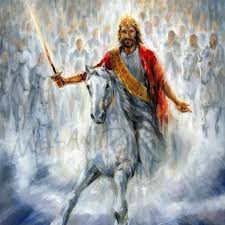
The Lord, A Sword?

Deuteronomy 33:29
“Blessed are you, Israel! Who is like you, a people saved by the Lord? He is your shield and helper and your glorious sword. …”

It’s wonderful how our God has many names. I’m taking a minute this evening to remember Jehovah Chereb, which means “the Lord, the sword” or “the Lord, sharp blade.”

A sword, a weapon with a long, sharp blade attached to a handle, is used for cutting or thrusting. Amazingly, the Lord would also be known in this context considering the other gentler ways he’s defined in character.

What’s interesting is when thinking about our Father’s mercy, kindness, and gentleness, we must also remember how righteous, powerful, and just he is. He is perfect in all of these things and more. As such, the Bible also describes him as one mighty in battle, our defense, who avenges and is a God of recompense. (Psalm 24:8, Psalm 89:18, Psalm 99:8, Jeremiah 51:56)

We also recognize a sword’s use in military power, authority, punitive justice, death, destruction, war, combat, slaughter, or violence. Historically, the Bible shows us God’s involvement in the use of these things when protecting his people or purposes.

Another way we see God related to a sword is his word in Ephesians 6:17 and Hebrews 4:12: “Take the helmet of salvation and the sword of the Spirit, which is the word of  God.” “ For the word of God is alive and active. Sharper than any double-edged sword, it penetrates even to dividing soul and spirit, joints and marrow; it judges the thoughts and attitudes of the heart.”

As we pray, we should remember to leave in God’s hands what he does best, which is everything. He doesn’t ask us to take on more than we can. Though He’s blessed us with many gifts and abilities, we should remember those attributes of His authority that far exceed ours. We don’t have to carry as a burden the hard things that life presents to us. He tells us to cast our cares on him because he cares for us. (Psalm 55:22 and 1 Peter 5:7)

God reveals our responsibilities in life but also makes his responsibilities clear. These are amazing things to ponder–his promises regarding how he chooses to relate to us. Studying his character in the Bible produces more confidence in his care for us and helps us to rest when seemingly unfortunate things happen that we have no control over. We can rest in the reality that “… all things God works for the good of those who love him, who have been called according to his purpose” (Romans 8:28).

In the meantime, we make our requests known to our heavenly Father and remain “joyful in hope, patient in affliction, faithful in prayer” (Romans 12:12), knowing He will handle everything according to his great wisdom and love. Seeing his hand in action in our lives produces further growth in our faith as God creates an astounding history of his willingness to come through for us when we need him most.

So, if any of you are wondering if any of this still applies to you today, please remember this spiritual truth of Galatians 3:26-29: “ So in Christ Jesus you are all children of God through faith, for all of you who were baptized into Christ have clothed yourselves with Christ. There is neither Jew nor Gentile, neither slave nor free, nor is there male and female, for you are all one in Christ Jesus. If you belong to Christ, then you are Abraham’s seed, and heirs according to the promise.”

—————————————-

More helpful reading:

Exodus 14:14
2 Chronicles 20:15
Deuteronomy 1:29-30
Deuteronomy 3:22
Isaiah 54:17
Psalm 35:1
1 Corinthians 15:57
Ephesians 6:10-12
Philippians 4:13
Luke 10:19
Romans 8:31-39

Housing God

2 Corinthians 4:7
But we have this treasure in earthen vessels, that the excellence of the power may be of God and not of us.

We carry the Lord’s treasure. Aren’t you glad about it? Another interesting translation of this verse is the New Living Translation: “We now have this light shining in our hearts, but we ourselves are like fragile clay jars containing this great treasure. This makes it clear that our great power is from God, not from ourselves.”

2 Corinthians 4 speaks of our knowledge of the glory of God by our faith in Jesus Christ; even though its containment is in fragile vessels the Bible speaks of as jars of clay. This is referred to repeatedly as the “light” and “life” of Jesus. We see these blessings we carry recorded in the following verses:

  • vs. 4 – “the light of the gospel of the glory of Christ, who is the image of God”
  • vs. 6 – “the light of the knowledge of the glory of God in the face of Jesus Christ”
  • vs. 10 – “always carrying about in the body the dying of the Lord Jesus, that the life of Jesus also may be manifested in our body”
  • vs. 11 – “the life of Jesus also may be manifested in our mortal flesh”

We carry his light and life in us. Hallelujah! As such, we can also know that we emit “rivers of living water” the Bible refers to as the Holy Spirit flowing from believers.

In John 7:38, Jesus says, “Whoever believes in me, as Scripture has said, rivers of living water will flow from within them.” The light and life of God come from his Holy Spirit within us. We are now the temple of his Holy Spirit. Not only do we carry the Lord’s light of the knowledge of the gospel, but the life of the gospel.

When I think of a treasure, I think of the Ark of the Covenant. God’s instructions found in Exodus 25:8 were: “Then have them make a sanctuary for me, and I will dwell among them…” “Place the cover on top of the ark and put in the ark the tablets of the covenant law that I will give you. There, above the cover between the two cherubim that are over the ark of the covenant law, I will meet with you and give you all my commands for the Israelites” (Exodus 25:21-22).

This glorious box, spoken of in the Old Testament of the Bible:

  • housed God’s spirit
  • had to be carried a special way by God-given instructions
  • brought blessings to God’s caregivers of the Ark
  • brought curses to the wrong guardians of the Ark

Now if you should wonder what the Ark of the Covenant might have to do with Christ, one vital message is: “For God wanted them to know that the riches and glory of Christ are for you Gentiles, too. And this is the secret: Christ lives in you. This gives you assurance of sharing his glory” (Colossians 1:27).

We must know how much God loves and thinks of us that he would allow us to carry his enlightenment and presence. We can be confident that “…His divine power has given to us all things that pertain to life and godliness, through the knowledge of Him who called us by glory and virtue” (2 Peter 1:3).

“Don’t you realize that your body is the temple of the Holy Spirit, who lives in you and was given to you by God? You do not belong to yourself,” (1 Corinthians 6:19/NLT).