Getting Along

Romans 12:18, NIV

 “If it is possible, as far as it depends on you, live at peace with everyone.

Do you increasingly find it difficult to get along well with others? Observing all of the arguing, misunderstandings and frustrations among those around us, and perhaps within ourselves, we could all use some tips on how to communicate.

It appears everybody is mad at somebody. Yet there are ways we can get along so much better and let me be the first in line to take notes on how to do so.

Here are some biblical instructions to help us in relating to others:

  1. “So in everything, do to others what you would have them do to you, for this sums up the Law and the Prophets” (Matthew 7:12, NIV). This involves imagining yourself as the other person or people, showing empathy, considering another person’s feelings, experiences, and emotions. How would you feel, and what would you do, if the shoe were on the other foot?
  2. “Be kind and compassionate to one another, forgiving each other, just as in Christ God forgave you” (Ephesians 4:32, NIV). In behaving this way, we are considerate, thoughtful, friendly and caring. We remember how we’ve needed God’s forgiveness. So, we extend forgiveness to others who have offended us. The Bible even goes so far as to show how what we do, determines how we’ll be treated. In other words, Matthew 6:14-15: “For if you forgive other people when they sin against you, your heavenly Father will also forgive you. But if you do not forgive others their sins, your Father will not forgive your sins.”
  3. “But encourage one another daily, as long as it is called “Today,” so that none of you may be hardened by sin’s deceitfulness” (Hebrews 3:13, NIV). This means we inspire one another with support, hope, and uplifting interaction, using words that edify one another. One can become cynical and feel hopeless, leading to bitterness, when they are consistently barraged with deception and wrongdoing. An encouraging word can make one’s day.
  4. “Therefore, confess your sins to each other and pray for each other so that you may be healed. The prayer of a righteous person is powerful and effective” (James 5:16, NIV). This is a very important part of getting along. It shows our need for, and trust in, God’s help toward others’ lives as well as ours. It shows humility to pray good things for someone else, as well as confess where we’ve missed the mark, especially when that person has hurt us.
  5. “Therefore, each of you must put off falsehood and speak truthfully to your neighbor, for we are all members of one body” (Ephesians 4:25, NIV). Consistently being honest with one another is a great way for trust to grow in our relationships. While our trust should be first and foremost in God, there is an element of trust we place in accepting and relying on someone as a true friend.
  6. “My dear brothers and sisters, take note of this: Everyone should be quick to listen, slow to speak and slow to become angry” (James 1:19, NIV). Sometimes, we can be so focused on what we want to say or how we will reply to someone, that we miss what the other person is actually saying in a conversation. This involves us sharpening our listening and attention skills, for the love of whoever we’re speaking with, listening closely to what they are communicating, so that we understand them well. We don’t want to be those quick to anger or dismissive of what is spoken.

The Bible shows us many ways of relating to one another successfully, but it takes much practice, humility and boldness to form good habits of communication, fellowship and friendship. It really is possible for us to get along with everyone, if we’ll just show one another grace in whatever our connections may be. God has masterfully provided us the scriptural information necessary to get along well. We must now ask for the power of God’s Holy Spirit to help us to do it.


Many Parts, Same Body

1 Corinthians 12:21-25

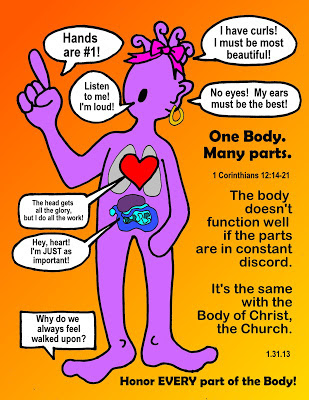
“The eye cannot say to the hand, “I don’t need you!” And the head cannot say to the feet, “I don’t need you!” On the contrary, those parts of the body that seem to be weaker are indispensable, and the parts that we think are less honorable we treat with special honor. And the parts that are unpresentable are treated with special modesty, while our presentable parts need no special treatment. But God has put the body together, giving greater honor to the parts that lacked it, so that there should be no division in the body, but that its parts should have equal concern for each other.”

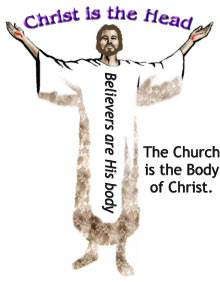
The Bible refers to those who have truly believed on Jesus Christ as the Son of God and accepted his death and resurrection as atonement for our sins, as the Body of Christ and the Church. “And God placed all things under his feet and appointed him to be head over everything for the church, which is his body, the fullness of him who fills everything in every way” (Ephesians 1:22-23). As such, one’s origin of birth, current residence, skin color, size, or economic status does not matter. Each believing individual is defined as the Body of Christ.

The Body of Christ consists of many members of local churches (those buildings used for gathering together to worship Christ among other things) in many places throughout the earth. Also included, are those who may not yet have a local church home, meet in homes, in person or over the Internet, but nevertheless, are believers.

In 1 Corinthians 12 where the Body of Christ is equated to a human body, this chapter speaks of the functions of various parts of the body and their necessity to one another.

It is no doubt common that some people may think they are not needed in the Body, or others, that they don’t need the Body. Yet there are many parts of the Body, and they are all important. Verse 24 tells us that while our presentable parts need no special treatment, God composed the Body, giving greater honor to the part that lacks it, that there wouldn’t be any division in the Body, but that the members would have the same care for one another.

As with a human body, some parts are more presentable to the public and don’t need special attention. While others, are kept clothed and covered, they are no less important to the body as a whole. These parts of the body are what some might consider “less honorable,” in that we don’t want them to be exposed or seen. They’re also parts we don’t want treated harshly or injured.

Yet, God gives greater honor to the parts which lack it, which may be seen as the weaker, less honorable, and unpresentable members of the Body, seeking the benefit of the whole body.

One might notice the Body’s different types of giftings or rich and poor persons of greater and lesser abilities. Nevertheless, they all have a role to fulfill.

There is room for variety in God’s great big, magnificent Body. Through prayer and various biblical resources of wisdom, we just need to know our gifts, find God’s best community fit for us, and remember to respect and honor one another despite our gifts or differences. As well we should appreciate our own unique abilities no matter how great or less they may appear to us.

We are not all the same, but we’ve been made a part of Christ’s Body, so we are family and should love and honor one another as we do Christ, the head. May God’s Holy Spirit, help us all in this endeavor.

Beloved Ambassadors of Reconciliation

2 Corinthians 5:20

“We are therefore Christ’s ambassadors, as though God were making his appeal through us. We implore you on Christ’s behalf: Be reconciled to God.”

What an honorable responsibility to be an ambassador for Christ. As such we have the exciting assignment to encourage reconciliation to God. As ambassadors, we are representatives. The Greek word, presbeuó, indicates those who represent Christ and speak for Him. We are authorized by Christ to act as diplomats speaking on his behalf.

Reconciliation is the restoration of friendly relations, with the key word here being restoration. When we restore something, we reinstitute or bring it back. We repair or renovate it returning it to its original condition. Merriam-Webster’s definition of “reconciliation” refers to the process of restoring friendship or harmony after a disagreement, settling a dispute, or making conflicting ideas or things consistent. This is what Christ has done for us. He has made a way of restoration to our place in God before man’s fall through sin.

Accepting the Father’s son, Jesus, as Lord and Savior, we become one with Him as his Body and He is the head. We recognize God’s kingdom instructions as those principles we choose to live and love by.

When we think of representing Christ, we endeavor to show the utmost behavior encompassing love, compassion and humility toward others. To represent someone well, also entails speaking on their behalf effectively and accurately. This includes understanding their position, communicating their needs, and advocating for their interests while maintaining integrity and respect.

With the propensity to err and encounter our personal insecurities and weaknesses, God still chooses to grace us with the posture of 1 Peter 2:9: “But you are a chosen generation, a royal priesthood, a holy nation, His own special people, that you may proclaim the praises of Him who called you out of darkness into His marvelous light.”

Moreover, the fact of the matter is the wonderful message of how we are reconciled. Romans 5:8-11 tells us that “…God demonstrates his own love for us in this: While we were still sinners, Christ died for us.

Since we have now been justified by his blood, how much more shall we be saved from God’s wrath through him! For if, while we were God’s enemies, we were reconciled to him through the death of his Son, how much more, having been reconciled, shall we be saved through his life! Not only is this so, but we also boast in God through our Lord Jesus Christ, through whom we have now received reconciliation.”

In giving us this amazing position in Christ, He has provided us with additional heavenly help as His ambassadors: “But you shall receive power when the Holy Spirit has come upon you; and you shall be witnesses to Me in Jerusalem, and in all Judea and Samaria, and to the end of the earth” (Acts 1:8).

My prayer is that we will all represent the Lord well, wherever we find ourselves in life.

Slay It!

2 Corinthians 7:1

“Therefore, since we have these promises, dear friends, let us purify ourselves from everything that contaminates body and spirit, perfecting holiness out of reverence for God.”

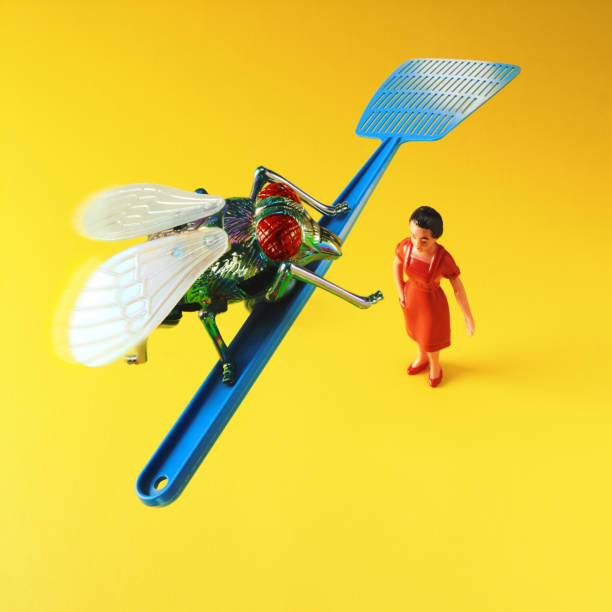
A fly has somehow entered my presence at this moment. With the pretty, pink and flowered, fly swatter in hand, I hate to destroy anything. So, I’m telling it where to go: “The air conditioning vents, under the door; just get out of here!” I’m experiencing it can be especially hard to put to death anything that is living, even when it is harassing me needlessly.

Nevertheless, the Bible tells us to put to death some harmful things that may be living within in us. These are things that seek to kill us, grieve God’s Holy Spirit, and hinder us from moving forward freely in our God-given purpose or enjoying a confident relationship with Christ.

As Christ has paid the price for our eternal life, we are now to kill those things within us that are clearly of Satan’s kingdom and replace them with those things of Christ’s.

Furthermore, though the Lord’s sanctification process is ongoing in our lives, the Bible clearly tells us that we are to do this ruining of certain things; making an effort to do the killing and not just expect God to do it for us. Thankfully, he’s given us the authority and tools to carry it out.

Colossians 3:5 tells us to “Put to death therefore what is earthly in you: sexual immorality, impurity, passion, evil desire, and covetousness, which is idolatry. Therefore, at some point, we’ve got to take a serious look, specifically at what each of these things are, with an aim to recognize them when they surface from within us and put an end to them.

Therefore, we can start by realizing that God has given us weapons. One, I’ll highlight here, is the “sword of the spirit” which the Bible defines as the Word of God.  “For the Word of God is living and active, sharper than any two-edged sword, piercing to the division of soul and of spirit, of joints and of marrow, and discerning the thoughts and intentions of the heart” (Hebrews 4:12).

When our human reasoning or excuses to behave in ungodly ways moves us closer toward sin, we must remember that “the weapons of our warfare are not of the flesh but have divine power to destroy strongholds. We destroy arguments and every lofty opinion raised against the knowledge of God and take every thought captive to obey Christ” (2 Corinthians 10:4-5).

Though we’re instructed to kill those things within us that are harmful to us and others, God has graciously given us some things to put on. Colossians 3:12 tells us, “Put on then, as God’s chosen ones, holy and beloved, compassionate hearts, kindness, humility, meekness, and patience.”

These things make life beautiful for us and those we encounter. These things bring God glory. They are the things that speak loudly that we are of the Lord’s kingdom, one where there is righteousness, peace and joy in the Holy Spirit.

Interestingly, as I reach the end of my minutes with you, my annoying visitor is no longer buzzing. Quietly, it left without my killing it, for which I am truly grateful. Yet, any bad habits we’ve been allowing in our lives, won’t just go away on their own, but must be put to death. So, I’m so appreciative that we can ask our heavenly father, who gives wisdom liberally, to show us specifically how to successfully remove anything that he hates from our lives. We can rest confident his tools of weaponry for us work, and he is certainly faithful to do his part in these matters.