
John 17:19
“For them I sanctify myself, that they too may be truly sanctified.” ~Jesus Christ
Knowing that God works in us to accomplish his goals for our lives is a privilege. He so graciously does his part, and we attempt to do ours. Hopefully, we all are successful since we don’t do this alone. Today, I’m remembering the acts of sanctification and consecration.
Now, one could get very long and deep into these two terms, but for the sake of time measurement in minutes, I just want to provoke thought and study on their definitions.

The act of sanctification is God’s way of making us holy; an ongoing work of the Holy Spirit in the hearts of his children. Other words we might see used for sanctifying are purification, cleansing, salvation, redemption, regeneration, or rebirth.
The following verse demonstrates how people are made holy–through God’s Holy Spirit: “to be a minister of Christ Jesus to the Gentiles. He gave me the priestly duty of proclaiming the gospel of God, so that the Gentiles might become an offering acceptable to God, sanctified by the Holy Spirit” (Romans 15:16).
1 Thessalonians 5:23 is a verse of encouragement that highlights the totality of being sanctified by God, keeping one guiltless or above reproach. “May God himself, the God of peace, sanctify you through and through. May your whole spirit, soul, and body be kept blameless at the coming of our Lord Jesus Christ.”
We’re chosen by God and as such, he has provided the provision of salvation by the Holy Spirit’s purifying labor, and via faith and the gospel. “But we ought always to thank God for you, brothers and sisters loved by the Lord, because God chose you as firstfruits to be saved through the sanctifying work of the Spirit and through belief in the truth” (2 Thessalonians 2:13).
The act of consecration is setting aside or dedicating people, places, or objects for God’s use. This word is sometimes used interchangeably with sanctification. Yet it can be used to describe devoting one’s self to God for his purposes or use, or God’s doing the same with us for himself.

In the following verse, God is requiring the consecration of his people, reminding them of the punishments for sin. This chapter lists a host of things God disliked and warned the Israelites to stay away from. “Consecrate yourselves and be holy, because I am the Lord your God. Keep my decrees and follow them. I am the Lord, who makes you holy” (Leviticus 20:7-8).
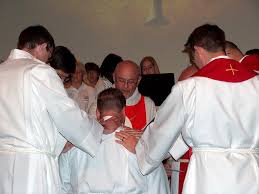
In Joshua 3-5, namely verse 5, Joshua prepares the people for God’s presence and actions even when faced with possible opposition and war. “Joshua told the people, ‘Consecrate yourselves, for tomorrow the Lord will do amazing things among you.”
The Lord’s mighty works, along with the Israelites’ consecration, brought about a wonderful display of God’s grace in their crossing at Jordan’s flood stage. They successfully passed by on dry ground as the waters piled up in a heap a distance away. Then, when the Amorite and Canaanite kings along the coast heard how the Lord had dried up the Jordan before the Israelites until they had crossed over, they were fearful and no longer dared to face them.
Later in the New Testament, we see references to consecrated objects, where food that God created to be received was told to be avoided. “They forbid people to marry and order them to abstain from certain foods, which God created to be received with thanksgiving by those who believe and who know the truth. For everything God created is good, and nothing is to be rejected if it is received with thanksgiving, because it is consecrated by the word of God and prayer.” (1 Timothy 4:3-5).
This event reminds me of Acts 10:10-20, where Peter, in a trance, is shown by God a sheet containing all kinds of four-footed animals, as well as reptiles and birds, and told by God to eat and not to call anything impure what he has cleansed.
As seen throughout the Bible, in consecration, God may ask us to fast, pray, dedicate, or give up something in preparation for a specific divine purpose.
In addition, other scriptures demonstrate these two vital works of God that involve his and our efforts. Yet some are interpreted in varying styles. Nevertheless, these things cause us “to will and to act in order to fulfill his good purpose” (Philippians 2:13).
Concluding on a light note 😂:
 Ms. Rita's Minute