“Blessed are all who fear the Lord, who walk in obedience to him. You will eat the fruit of your labor; blessings and prosperity will be yours.”
I love this passage. It shows us who the blessed are and their reward. We may have many personal definitions of blessed, but the Hebrew word, in this context, is ašrê and indicates happiness, joy, and favor.
This is promised to all, not just some, but all who fear the Lord. Fear, as written here, is a reverential awe and respect for God, rather than a feeling of terror, leading to obedience. The blessings of obedience come from aligning one’s life with God’s will and promises.
In these blessings of obedience, we eat the fruit of our labor and receive from the work or effort of our hands. With this comes prosperity: “You shall be happy, and it shall be well with you” (Psalm 128:2 KJV). The Hebrew word for prosperity here is tov, which signifies a state of flourishing and positive outcomes resulting from one’s work.
Thankfully, we have the Bible to aid us in knowing what God’s will and ways are as we move in reverential fear of him. However, sometimes God’s will for us personally, in various practical parts of our lives, may not look like what we, or others, think it should.
That’s why it’s not wise to be hasty, but seek the Lord in prayer as to His desires for us in our decision-making. He’ll be faithful to give us the signposts to follow, so that we’ll stay on his blessed pathway. All we need to do is sincerely ask and wait for His answer, remembering the Lord sees our honor and respect for Him.
Romans 12:2 “Do not conform to the pattern of this world, but betransformed by the renewing of your mind. Then you will be able to test and approve what God’s will is—his good, pleasing and perfect will.”
Are there things about you that you know just aren’t good? You know, those things you don’t like about yourself that you know need to change, but you’ve so far been unsuccessful? Well, there’s good news for all of us!
God has given us instructions on how we can be transformed: by the renewing of our minds. This is how we change. The consistent reading of the Bible is just that powerful. It’s a process by which we persistently take in the scriptures to learn the principles and patterns of God’s love, works, and ways. We learn what he desires of us and those actions and disciplines we need to set in place in our journeys toward change.
How seriously we embrace His instructions determines the time or pace at which we experience successful change. With our various upbringings, environments, jobs, hobbies, leaders, friends, etc., the rate of change will differ. However, given the Bible, God’s Holy Spirit, our commitments, and other resources the Lord uses specifically in our lives, we will experience change.
Most of all, recognition of our need for change and the willingness to do it are huge factors in successful transformation. Not to mention, that miraculous supernatural thing God does, while “we all, with unveiled face, beholding as in a mirror the glory of the Lord, are being transformed into the same image from glory to glory, just as by the Spirit of the Lord” (2 Corinthians 3:18).
What’s really comforting is Philippians 1:6 assures us that we can be confident that he who began a good work in us will carry it on to completion until the day of Christ Jesus. We aren’t abandoned to try to figure everything out on our own. God has given us the Holy Spirit as a helper to guide us into all the truth we need to mature in the faith.
The Holy Spirit empowers believers to resist temptation and live a life of holiness, overcoming sinful patterns and developing godly character. This includes cultivating virtues like love, joy, peace, patience, kindness, goodness, faithfulness, gentleness, and self-control, often referred to as the “fruit of the Spirit” (Galatians 5:22-23). The Holy Spirit faithfully assists to make us more like Christ.
Our transformation involves a change of heart and mind, leading to a new identity and a desire to live according to God’s will. It’s a process of spiritual formation that is initiated and enabled by God but also requires our active participation and cooperation.
One might simply list the things we’d like to change and then pray earnestly about those things, seeking God’s truth on the matter. He’s so creative and helps us in many unique ways to modify our behavior in order to bring about positive results. I’ve found the Lord to be a masterful teacher using many life lessons in various forms to get me to see his necessary points. Yet we are responsible to check the condition of our behaviors to assess if we are learning and doing what God says.
The Bible says, “Examine yourselves to see whether you are in the faith; test yourselves. Do you not realize that Christ Jesus is in you—unless, of course, you fail the test?” (2 Corinthians 13:5) We must be humble enough to submit our weaknesses to the Lord with a repentant and intentional attitude to do better by the grace of His presence within us and the strength of discipline that he provides.
Moreover, we can move bravely knowing that God has said in Hebrews 13:5 that He will never leave or forsake us and in John 14:18, he would not leave us as orphans but would come to us.
“But seek first his kingdom and his righteousness, and all these things will be given to you as well.”
As human beings we all have desires, interests, and our own personal ways of doing and being. We have our own definitions of success and how to obtain it. We seek happiness and contentment in various ways and pursue those things that we think will fulfill our souls.
However, do we ever consider what God wants us to pursue? What are His desires for each of us and what truly fulfills those personal longings we possess? I ponder this often as sometimes I can get distracted but find joy in the answers God has given.
1 Timothy 6:11 provides those things God wants us to pursue. These things are of utmost importance that spill over into everything else in our lives: “… pursue righteousness, godliness, faith, love, endurance and gentleness.” 2 Timothy 2:22 adds “peace” to the list. To look a little closely to each of these traits:
Pursuing righteousness we seek being morally right or justifiable, decent, just, principled and virtuous among other things. As the Body of Christ, we’ve already spiritually received God’s gift of righteousness. However, our proof of repentance and living for Christ include the aforementioned characteristics.
Godliness is living a life that reflects the character and will of God. We are told in 1 Timothy 6:6 that righteousness along with contentment is great gain.
The Bible also teaches us in Hebrews 11:6 that faith is the confidence, or substance of things we hope for, the assurance, or evidence of things we can’t see.
1 Corinthians 13 is an entire chapter that defines the attributes of love, a wonderful state encompassing patience, kindness, and selflessness. 1 John 4:8 and 4:16 tell us that God is love.
Endurance is the ability to sustain a prolonged stressful effort or activity, or to withstand hardship or adversity.
We display gentleness when we are kind, tender and mild-mannered. It also involves humility, patience and empathy.
When we pursue peace, we pursue harmony and tranquility; freedom from emotional distress, worry, or public disturbance.
The traits listed in 1 Timothy 6:11 are preceded by Paul’s warning on how the love of money is the root of all evil and how people so eager for it have caused themselves many griefs and wandered from the faith because of it. He encourages his son in the faith, Timothy, to flee from those things and to fight the good fight of faith.
This, of course, is also a warning to all believers in Christ. Fleeing involves running away to escape danger; to move quickly and with urgency.
There’s nothing wrong with having dreams, goals, ideas or visions for our lives, but we must keep in close contact with our Wonderful Counselor, Peleh Yoetz (in Hebrew), to make sure our desires align with his. “Grinding” to achieve success is not always healthy or safe, especially when it moves us away from God’s ideals.
We don’t want to add any more weights to our lives than that with which we already have to contend. The Lord knows the best ways for us to do anything to achieve success. We need only ask for his wisdom which he’ll provide generously without finding fault according to James 1:5.
In our pursuits of happiness, contentment or whatever it is we desire in life, keeping our focus first and foremost on heavenly goals leads to joy and fulfillment for God’s children. Steering away from distractions can sometimes prove difficult, but doable.
We have the Spirit of the living God on the inside of us and this is marvelous. Now may we continue to fight the good fight of faith in our endeavors to do his will.
John 3:3 Jesus replied, “Very truly I tell you, no one can see the kingdom of God unless they are born again.”
Isn’t it an awe-inspiring fact that one can become reborn? When I think of the awesomeness of natural birth and its wonderful process, the thought of actually being reborn can be even more mindboggling.
The curious Pharisee, Nicodemus, one who apparently knew of, or observed some works that Jesus had done, wondered how this could be. He questioned the Lord: “How can someone be born when they are old?” “Surely they cannot enter a second time into their mother’s womb to be born” (John 3:4)! Jesus responded telling him that “Flesh gives birth to flesh, but the Spirit to spirit” (John 3:6).
The magnificent Holy Spirit is the one who gives this new birth to our spirits! In as much as we have believed on the Lord Jesus as the Son of God and repented of our sins, we are not the same people. 2 Corinthians 5:17 tells us, “… if anyone is in Christ, the new creation has come: The old has gone, the new is here!” Not only that, but we have been “… born again, not of perishable seed, but of imperishable, through the living and enduring word of God” (1 Peter 1:23).
Of all the millions of people on the earth, the Lord has created the standard that “…no one can enter the kingdom of God unless they are born of water and the Spirit…‘You must be born again.’ (John 3:5-7) Hence, we must come into this new existence in Christ, in order to enter His Kingdom. As stated in the Bible, this can only be done by believing on the Lord Jesus Christ and accepting Him as Lord, God’s only begotten son.
How refreshing to know that no matter what we may have experienced that we wish to forget in our pasts, before knowing Christ, it’s as good as gone when we have been reborn. It’s stated to be under the blood of Jesus, through the atonement of His death on our behalf, and we are given the gift of a new life, eternal life.
So I highlight this fact today so that we don’t forget that in being reborn, we should not see ourselves as the same as before this amazing supernatural act. “For he has rescued us from the dominion of darkness and brought us into the kingdom of the Son he loves” (Colossians 1:13).
In addition, according to 2 Corinthians 3:18, “… we all, who with unveiled faces contemplate the Lord’s glory, are being transformed into his image with ever-increasing glory, which comes from the Lord, who is the Spirit.”
It is a wonderful act of God’s grace that He “chose us as first fruits to be saved through the sanctifying work of the Spirit and through belief in the truth” (2 Thessalonians 2:13).
Hence, we should not see ourselves as the persons we were, slaves to the same old habits, laden with the generational strongholds, addictions and maladies of old, never changing. Our old selves were crucified with Christ. We now walk in newness of life in Christ, in the Holy Spirit.
Moreover, Jesus himself said we are now the “…salt of the earth, the light of the world…” (Matthew 5:13-16). So, now we may rejoice that we have an awesome birthright: “And you also were included in Christ when you heard the message of truth, the gospel of your salvation. When you believed, you were marked in him with a seal, the promised Holy Spirit, who is a deposit guaranteeing our inheritance until the redemption of those who are God’s possession—to the praise of his glory” (Ephesians 1:13-14)
Biblically, a Christian’s inheritance contains both present and future realities. We can count on blessings in this life, such as forgiveness of our sins through Christ, adoption into God’s family, and the gift of the Holy Spirit. It also includes eternal life with God in heaven, and a new heaven and new earth. This inheritance is secured by faith in Jesus Christ and is a gift from God. So, let’s praise the Lord today that we’ve been reborn!
“If it is possible, as far as it depends on you, live at peace with everyone.“
Do you increasingly find it difficult to get along well with others? Observing all of the arguing, misunderstandings and frustrations among those around us, and perhaps within ourselves, we could all use some tips on how to communicate.
It appears everybody is mad at somebody. Yet there are ways we can get along so much better and let me be the first in line to take notes on how to do so.
Here are some biblical instructions to help us in relating to others:
“So in everything, do to others what you would have them do to you, for this sums up the Law and the Prophets”(Matthew 7:12, NIV). This involves imagining yourself as the other person or people, showing empathy, considering another person’s feelings, experiences, and emotions. How would you feel, and what would you do, if the shoe were on the other foot?
“Be kind and compassionate to one another, forgiving each other, just as in Christ God forgave you”(Ephesians 4:32, NIV). In behaving this way, we are considerate, thoughtful, friendly and caring. We remember how we’ve needed God’s forgiveness. So, we extend forgiveness to others who have offended us. The Bible even goes so far as to show how what we do, determines how we’ll be treated. In other words, Matthew 6:14-15: “For if you forgive other people when they sin against you, your heavenly Father will also forgive you. But if you do not forgive others their sins, your Father will not forgive your sins.”
“But encourage one another daily, as long as it is called “Today,” so that none of you may be hardened by sin’s deceitfulness”(Hebrews 3:13, NIV). This means we inspire one another with support, hope, and uplifting interaction, using words that edify one another. One can become cynical and feel hopeless, leading to bitterness, when they are consistently barraged with deception and wrongdoing. An encouraging word can make one’s day.
“Therefore, confess your sins to each other and pray for each other so that you may be healed. The prayer of a righteous person is powerful and effective”(James 5:16, NIV). This is a very important part of getting along. It shows our need for, and trust in, God’s help toward others’ lives as well as ours. It shows humility to pray good things for someone else, as well as confess where we’ve missed the mark, especially when that person has hurt us.
“Therefore, each of you must put off falsehood and speak truthfully to your neighbor, for we are all members of one body”(Ephesians 4:25, NIV). Consistently being honest with one another is a great way for trust to grow in our relationships. While our trust should be first and foremost in God, there is an element of trust we place in accepting and relying on someone as a true friend.
“My dear brothers and sisters, take note of this: Everyone should be quick to listen, slow to speak and slow to become angry”(James 1:19, NIV). Sometimes, we can be so focused on what we want to say or how we will reply to someone, that we miss what the other person is actually saying in a conversation. This involves us sharpening our listening and attention skills, for the love of whoever we’re speaking with, listening closely to what they are communicating, so that we understand them well. We don’t want to be those quick to anger or dismissive of what is spoken.
The Bible shows us many ways of relating to one another successfully, but it takes much practice, humility and boldness to form good habits of communication, fellowship and friendship. It really is possible for us to get along with everyone, if we’ll just show one another grace in whatever our connections may be. God has masterfully provided us the scriptural information necessary to get along well. We must now ask for the power of God’s Holy Spirit to help us to do it.
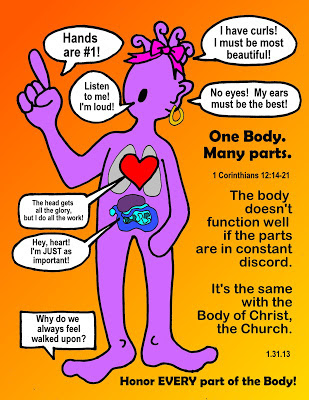
“The eye cannot say to the hand, “I don’t need you!” And the head cannot say to the feet, “I don’t need you!” On the contrary, those parts of the body that seem to be weaker are indispensable, and the parts that we think are less honorable we treat with special honor. And the parts that are unpresentable are treated with special modesty, while our presentable parts need no special treatment. But God has put the body together, giving greater honor to the parts that lacked it, so that there should be no division in the body, but that its parts should have equal concern for each other.”
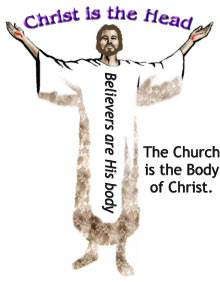
The Bible refers to those who have truly believed on Jesus Christ as the Son of God and accepted his death and resurrection as atonement for our sins, as the Body of Christ and the Church. “And God placed all things under his feet and appointed him to be head over everything for the church, which is his body, the fullness of him who fills everything in every way” (Ephesians 1:22-23). As such, one’s origin of birth, current residence, skin color, size, or economic status does not matter. Each believing individual is defined as the Body of Christ.
The Body of Christ consists of many members of local churches (those buildings used for gathering together to worship Christ among other things) in many places throughout the earth. Also included, are those who may not yet have a local church home, meet in homes, in person or over the Internet, but nevertheless, are believers.
In 1 Corinthians 12 where the Body of Christ is equated to a human body, this chapter speaks of the functions of various parts of the body and their necessity to one another.
It is no doubt common that some people may think they are not needed in the Body, or others, that they don’t need the Body. Yet there are many parts of the Body, and they are all important. Verse 24 tells us that while our presentable parts need no special treatment, God composed the Body, giving greater honor to the part that lacks it, that there wouldn’t be any division in the Body, but that the members would have the same care for one another.
As with a human body, some parts are more presentable to the public and don’t need special attention. While others, are kept clothed and covered, they are no less important to the body as a whole. These parts of the body are what some might consider “less honorable,” in that we don’t want them to be exposed or seen. They’re also parts we don’t want treated harshly or injured.
Yet, God gives greater honor to the parts which lack it, which may be seen as the weaker, less honorable, and unpresentable members of the Body, seeking the benefit of the whole body.
One might notice the Body’s different types of giftings or rich and poor persons of greater and lesser abilities. Nevertheless, they all have a role to fulfill.
There is room for variety in God’s great big, magnificent Body. Through prayer and various biblical resources of wisdom, we just need to know our gifts, find God’s best community fit for us, and remember to respect and honor one another despite our gifts or differences. As well we should appreciate our own unique abilities no matter how great or less they may appear to us.
We are not all the same, but we’ve been made a part of Christ’s Body, so we are family and should love and honor one another as we do Christ, the head. May God’s Holy Spirit, help us all in this endeavor.
“We are therefore Christ’s ambassadors, as though God were making his appeal through us. We implore you on Christ’s behalf: Be reconciled to God.”
What an honorable responsibility to be an ambassador for Christ. As such we have the exciting assignment to encourage reconciliation to God. As ambassadors, we are representatives. The Greek word, presbeuó, indicates those who represent Christ and speak for Him. We are authorized by Christ to act as diplomats speaking on his behalf.
Reconciliation is the restoration of friendly relations, with the key word here being restoration. When we restore something, we reinstitute or bring it back. We repair or renovate it returning it to its original condition. Merriam-Webster’s definition of “reconciliation” refers to the process of restoring friendship or harmony after a disagreement, settling a dispute, or making conflicting ideas or things consistent. This is what Christ has done for us. He has made a way of restoration to our place in God before man’s fall through sin.
Accepting the Father’s son, Jesus, as Lord and Savior, we become one with Him as his Body and He is the head. We recognize God’s kingdom instructions as those principles we choose to live and love by.
When we think of representing Christ, we endeavor to show the utmost behavior encompassing love, compassion and humility toward others. To represent someone well, also entails speaking on their behalf effectively and accurately. This includes understanding their position, communicating their needs, and advocating for their interests while maintaining integrity and respect.
With the propensity to err and encounter our personal insecurities and weaknesses, God still chooses to grace us with the posture of 1 Peter 2:9: “But you are a chosen generation, a royal priesthood, a holy nation, His own special people, that you may proclaim the praises of Him who called you out of darkness into His marvelous light.”
Moreover, the fact of the matter is the wonderful message of how we are reconciled. Romans 5:8-11 tells us that “…God demonstrates his own love for us in this: While we were still sinners, Christ died for us.
Since we have now been justified by his blood, how much more shall we be saved from God’s wrath through him! For if, while we were God’s enemies, we were reconciled to him through the death of his Son, how much more, having been reconciled, shall we be saved through his life! Not only is this so, but we also boast in God through our Lord Jesus Christ, through whom we have now received reconciliation.”
In giving us this amazing position in Christ, He has provided us with additional heavenly help as His ambassadors: “But you shall receive power when the Holy Spirit has come upon you; and you shall be witnesses to Me in Jerusalem, and in all Judea and Samaria, and to the end of the earth” (Acts 1:8).
My prayer is that we will all represent the Lord well, wherever we find ourselves in life.
“Therefore, since we have these promises, dear friends, let us purify ourselves from everything that contaminates body and spirit, perfecting holiness out of reverence for God.”
A fly has somehow entered my presence at this moment. With the pretty, pink and flowered, fly swatter in hand, I hate to destroy anything. So, I’m telling it where to go: “The air conditioning vents, under the door; just get out of here!” I’m experiencing it can be especially hard to put to death anything that is living, even when it is harassing me needlessly.
Nevertheless, the Bible tells us to put to death some harmful things that may be living within in us. These are things that seek to kill us, grieve God’s Holy Spirit, and hinder us from moving forward freely in our God-given purpose or enjoying a confident relationship with Christ.
As Christ has paid the price for our eternal life, we are now to kill those things within us that are clearly of Satan’s kingdom and replace them with those things of Christ’s.
Furthermore, though the Lord’s sanctification process is ongoing in our lives, the Bible clearly tells us that we are to do this ruining of certain things; making an effort to do the killing and not just expect God to do it for us. Thankfully, he’s given us the authority and tools to carry it out.
Colossians 3:5 tells us to “Put to death therefore what is earthly in you: sexual immorality, impurity, passion, evil desire, and covetousness, which is idolatry. Therefore, at some point, we’ve got to take a serious look, specifically at what each of these things are, with an aim to recognize them when they surface from within us and put an end to them.
Therefore, we can start by realizing that God has given us weapons. One, I’ll highlight here, is the “sword of the spirit” which the Bible defines as the Word of God. “For the Word of God is living and active, sharper than any two-edged sword, piercing to the division of soul and of spirit, of joints and of marrow, and discerning the thoughts and intentions of the heart” (Hebrews 4:12).
When our human reasoning or excuses to behave in ungodly ways moves us closer toward sin, we must remember that “the weapons of our warfare are not of the flesh but have divine power to destroy strongholds. We destroy arguments and every lofty opinion raised against the knowledge of God and take every thought captive to obey Christ” (2 Corinthians 10:4-5).
Though we’re instructed to kill those things within us that are harmful to us and others, God has graciously given us some things to put on. Colossians 3:12 tells us, “Put on then, as God’s chosen ones, holy and beloved, compassionate hearts, kindness, humility, meekness, and patience.”
These things make life beautiful for us and those we encounter. These things bring God glory. They are the things that speak loudly that we are of the Lord’s kingdom, one where there is righteousness, peace and joy in the Holy Spirit.
Interestingly, as I reach the end of my minutes with you, my annoying visitor is no longer buzzing. Quietly, it left without my killing it, for which I am truly grateful. Yet, any bad habits we’ve been allowing in our lives, won’t just go away on their own, but must be put to death. So, I’m so appreciative that we can ask our heavenly father, who gives wisdom liberally, to show us specifically how to successfully remove anything that he hates from our lives. We can rest confident his tools of weaponry for us work, and he is certainly faithful to do his part in these matters.
“For them I sanctify myself, that they too may be truly sanctified.” ~Jesus Christ
Knowing that God works in us to accomplish his goals for our lives is a privilege. He so graciously does his part, and we attempt to do ours. Hopefully, we all are successful since we don’t do this alone. Today, I’m remembering the acts of sanctification and consecration.
Now, one could get very long and deep into these two terms, but for the sake of time measurement in minutes, I just want to provoke thought and study on their definitions.
The act of sanctification is God’s way of making us holy; an ongoing work of the Holy Spirit in the hearts of his children. Other words we might see used for sanctifying are purification, cleansing, salvation, redemption, regeneration, or rebirth.
The following verse demonstrates how people are made holy–through God’s Holy Spirit: “to be a minister of Christ Jesus to the Gentiles. He gave me the priestly duty of proclaiming the gospel of God, so that the Gentiles might become an offering acceptable to God, sanctified by the Holy Spirit” (Romans 15:16).
1 Thessalonians 5:23 is a verse of encouragement that highlights the totality of being sanctified by God, keeping one guiltless or above reproach. “May God himself, the God of peace, sanctify you through and through. May your whole spirit, soul, and body be kept blameless at the coming of our Lord Jesus Christ.”
We’re chosen by God and as such, he has provided the provision of salvation by the Holy Spirit’s purifying labor, and via faith and the gospel. “But we ought always to thank God for you, brothers and sisters loved by the Lord, because God chose you as firstfruits to be saved through the sanctifying work of the Spirit and through belief in the truth” (2 Thessalonians 2:13).
The act of consecration is setting aside or dedicating people, places, or objects for God’s use. This word is sometimes used interchangeably with sanctification. Yet it can be used to describe devoting one’s self to God for his purposes or use, or God’s doing the same with us for himself.
In the following verse, God is requiring the consecration of his people, reminding them of the punishments for sin. This chapter lists a host of things God disliked and warned the Israelites to stay away from. “Consecrate yourselves and be holy, because I am the Lord your God. Keep my decrees and follow them. I am the Lord, who makes you holy” (Leviticus 20:7-8).
In Joshua 3-5, namely verse 5, Joshua prepares the people for God’s presence and actions even when faced with possible opposition and war. “Joshua told the people, ‘Consecrate yourselves, for tomorrow the Lord will do amazing things among you.”
The Lord’s mighty works, along with the Israelites’ consecration, brought about a wonderful display of God’s grace in their crossing at Jordan’s flood stage. They successfully passed by on dry ground as the waters piled up in a heap a distance away. Then, when the Amorite and Canaanite kings along the coast heard how the Lord had dried up the Jordan before the Israelites until they had crossed over, they were fearful and no longer dared to face them.
Later in the New Testament, we see references to consecrated objects, where food that God created to be received was told to be avoided. “They forbid people to marry and order them to abstain from certain foods, which God created to be received with thanksgiving by those who believe and who know the truth. For everything God created is good, and nothing is to be rejected if it is received with thanksgiving, because it is consecrated by the word of God and prayer.” (1 Timothy 4:3-5).
This event reminds me of Acts 10:10-20, where Peter, in a trance, is shown by God a sheet containing all kinds of four-footed animals, as well as reptiles and birds, and told by God to eat and not to call anything impure what he has cleansed.
As seen throughout the Bible, in consecration, God may ask us to fast, pray, dedicate, or give up something in preparation for a specific divine purpose.
In addition, other scriptures demonstrate these two vital works of God that involve his and our efforts. Yet some are interpreted in varying styles. Nevertheless, these things cause us “to will and to act in order to fulfill his good purpose” (Philippians 2:13).
“For in Christ Jesus neither circumcision nor uncircumcision has any value. The only thing that counts is faith expressing itself through love.”
Have you ever thought about which is more important: faith or love? These are two vital aspects of one’s Christian walk. “Now faith is confidence in what we hope for and assurance about what we do not see” (Hebrews 11:1). Not to mention, “And without faith it is impossible to please God, because anyone who comes to him must believe that he exists and that he rewards those who earnestly seek him” (Hebrews 11:6).
Additionally, “If I speak in the tongues of men or of angels, but do not have love, I am only a resounding gong or a clanging cymbal. If I have the gift of prophecy and can fathom all mysteries and all knowledge, and if I have a faith that can move mountains, but do not have love, I am nothing. If I give all I possess to the poor and give over my body to hardship that I may boast, but do not have love, I gain nothing” (1 Corinthians 13:1-3).
There are many ways to study faith and love and much can be discussed about them. However, since this blog is meant to be simple and not many minutes, I’d just like to share a few thoughts.
Learning the principles of these two attributes are of paramount importance to a Christ follower. Perhaps faith is not currently taught as often in church as in the past because of the real or assumed mismanagement of the Bible’s teaching on faith. However, because of some teachers’ mishandling, whether intentional or not, we mustn’t avoid the many scriptures on faith and how they relate to our lives.
Jesus certainly made clear the importance of it in the lives of his followers, so we should as well. This involves following and teaching those elements of faith that seem impossible or difficult to believe. I call them SUPERnatural factors. If we don’t, we rob ourselves of the necessary elements for successful Christian living and bringing God the glory we should allow shown in our lives.
Furthermore, without faith, we can’t experience the salvation Jesus provided us with his death and resurrection. It is the main attribute in personally receiving Jesus as Lord and Savior; believing He died for our sins and rose again. It must remain a large portion of our teaching as in varying instances with Jesus actions and teachings, faith was required.
Likewise, “Love does no harm to a neighbor. Therefore love is the fulfillment of the law” (Romans 13:10). As this wonderful action is continually exercised, it flows into everything we do and protectively affects any temptations to sin. Our measurement of love is seen in how we treat God, ourselves, and others.
A critical notion is, “As the body without the spirit is dead, so faith without deeds is dead” (James 2:26). So, if we show no love in our behavior, our faith has no life. When we have faith, we believe, trust and stand on the truth of the matter. If we have love, we show consideration, compassion and respect for others.
There will be many opportunities in life for us to practice faith and love. I want to learn all I can about both so as to put them more increasingly to work in my life, as well as teach them to others. The Bible shows there are also wonderful benefits to demonstrating each and there’s no harm in desiring them.